Academic Freedom
Key Findings
- Key Finding 1
Academic freedom has long been a core value of higher education, widely adopted by universities and state governments, on the basis of the understanding that encouraging viewpoint diversity and protecting the free exchange of ideas are central to the truth-seeking mission of the academy.
Academic tenure and other policies and norms of higher education are specific mechanisms designed to serve as protections against persecution of professors for their ideas and research.
- Key Finding 2
Legal decisions about academic freedom have not yet yielded clarity about importance or scope of academic freedom.
Court decisions often turn on the dividing line between employee conduct (as unprotected speech) and protected speech. Most legal rulings to date regarding faculty academic speech controversies have supported the ability of colleges and universities to discipline professors for speech uttered on campus or in their capacity as employees, providing faculty members with limited protections to speak their mind if the content of that speech offends their employer, colleagues or students.
- Key Finding 3
Campus surveys indicate that faculty are concerned about being punished for their opinions and that many faculty and students regularly self-censor their speech because they fear such punishment.
There is evidence of self-censorship among faculty of all political persuasions, but the available data show that the concern is higher among self-reported moderate and conservative professors. Survey data also show that college students say they refrain from sharing views that they think are controversial. Students appear to be less supportive of academic freedom norms than faculty are.
- Key Finding 4
Much of the current policy discussion regarding academic freedom centers on institutional neutrality, the concept that higher education institutions should not take official positions on controversies of the day, unless they explicitly pertain to the mission of the institution.
While some colleges and universities have adopted policies of institutional neutrality, many have not, and it is unclear how well institutions with these commitments actually stick to them. By taking positions on controversies of the day, institutions may chill the speech of faculty or students who hold different views.
Introduction
Academic freedom is the professional liberty of scholars to teach, research, publish, and speak without institutional censorship or retaliation as long as the expressions are protected by the First Amendment to the U.S. Constitution as traditionally interpreted.
The scope and nature of academic freedom protections differ in the postsecondary and K–12 contexts. Tenure employment protections in K–12 are based on time in the position and due process guarantees and often negotiated by unions, whereas postsecondary tenure arrangements are justified mainly on the basis of professors' need to be able to research controversial topics and share their opinions in academic forums without fear of employer sanction. When courts rule on free speech cases brought by professors, they generally apply a mix of both traditional First Amendment law and historical professional norms as articulated by advocacy organizations such as the American Association of University Professors (AAUP). Policies that support academic freedom in the postsecondary field include tenure for professors and institutional commitments to free expression such as those embodied in the University of Chicago’s Chicago Principles and in the Kalven Report. Key factors that usually determine how a court rules in academic freedom cases include the relatedness of the speech to teaching and scholarship and the degree of disruption to the classroom or university attributed to the speech.
Academic freedom has long been a core value of higher education based on the understanding that encouraging viewpoint diversity and protecting the free exchange of ideas are central to the academy's truth-seeking mission. Recent controversy surrounding academic freedom in the U.S. centers on the dearth of viewpoint diversity in some academic disciplines, the dividing line between speech and impermissible conduct, and what qualifies as unprotected speech.
Campus surveys indicate that many faculty worry about being punished for the content of their teaching and research. The results also show that faculty overwhelmingly support basic norms of academic freedom while student support for those norms is less widespread. Specifically, recent data show that upwards of one-third of faculty and one-fifth of students report frequently self-censoring their speech. While student views of campus free speech are important, this essay focuses primarily on faculty matters.
Some national organizations that support academic freedom urge more colleges and universities to embrace the commitments in the Chicago Principles and the Kalven Report, though few institutions have established those principles as official policy.
To better understand and address these pressing issues, more student and faculty surveys on academic freedom and the campus free-speech environment are sorely needed. The populations surveyed should be expanded to graduate students and staff. Multiple organizations should replicate the existing survey findings, which are largely restricted to a single organization. Research (especially causal research) on the relationships between a university’s free expression climate and other positive indicators of a university community—such as research output, trust from the general public, and student and staff satisfaction—would also improve our understanding of the topic.
Background: State and federal policies
At the federal level, academic freedom is litigated as a “special concern” of the civil liberties protected by the First Amendment of the U.S. Constitution.1 The major federal law governing higher education, the Higher Education Act of 1965, expresses the sentiment of Congress that “an institution of higher education should facilitate the free and open exchange of ideas”2 but nothing more directly on academic freedom.
State constitutional protections. A few state constitutions have provisions that have been applied to academic freedom. A good example is the New Jersey state constitution which says, “Every person may freely speak, write and publish his sentiments on all subjects, being responsible for the abuse of that right. No law shall be passed to restrain or abridge the liberty of speech or of the press.”3 The California state constitution contains a similar clause.4
State laws and policies. There are a few aspects of state policy that bear on academic freedom. Some institutions enact academic freedom policies through their board of trustees or provide it as a contractual right in the faculty handbook.5 Although some schools have done this unprompted, a few states, including Arizona, Arkansas, and North Carolina, have passed laws that require university governing boards to adopt these policies.
Evidence
Key finding #1: Academic freedom has long been a core value of higher education, widely adopted by universities and state governments, on the basis of the understanding that encouraging viewpoint diversity and protecting the free exchange of ideas are central to the truth-seeking mission of the academy.
Postsecondary academic freedom has a rich, century-long history in the U.S. Although there are some scattered instances of conflicts in higher education prior to the 1890s,6 researchers generally mark the beginning of academic freedom with the Ross affair at Stanford University in 1896. Economist Edward Ross criticized the labor practices in the building of the Transcontinental Railroad and drew the ire of Jane Stanford, the widow of railroad magnate Leland Stanford, Jr., founder of the eponymous university. Ross was heavily pressured to resign, which he later did. Several other Stanford professors also resigned in protest.7 One of them, philosopher Arthur Lovejoy, joined with education philosopher John Dewey to found the AAUP. Its 1915 Declaration of Principles asserts that professors must be afforded the freedom to engage their students in dialogue over difficult topics and to engage with unorthodox modes of thinking that they themselves do not claim to endorse.8 The declaration holds that university governing boards “have no moral right to bind the reason or the conscience of any professor” and that when professors are pressured to avoid saying what they think, “the virtue of the instruction as an educative force is incalculably diminished.”9
The AAUP issued its second declaration in 1940,10 with the stated purpose of “promot[ing] public understanding and support of academic freedom and tenure and agreement upon procedures to ensure them in colleges and universities.” It also recognized that the public may interpret faculty outspokenness as a reflection of the university as employer.11 This declaration was published in the context of an increase in the number of Communist student and faculty groups, primarily at colleges in the Northeast and pockets of the West Coast, beginning in the 1930s. The 1950s saw a more severe intrusion into academic freedom and the freedom to associate when McCarthyism—the second “red scare”—pervaded American government and culture.12 Some academic freedom advocates have criticized the AAUP’s leadership at that time for failing to strike back against Senator Joseph McCarthy’s House Un-American Activities Committee and Senator Patrick McCarran’s Senate Internal Security Subcommittee. Historians estimate that several dozen, possibly up to one hundred, professors were fired on suspicion of having Communist Party ties.13
The University of California System was the locus of academic freedom concerns in the 1960s and 1970s. University of California – Los Angeles philosophy graduate student14 Angela Davis was fired by the Board of Regents for speeches she gave at Faculty Senate meetings, along with her statement that political activism was more important to her than completing her PhD requirements.15 After the 15–6 termination vote, UCLA’s Faculty Senate requested that the AAUP form a small committee to determine whether Davis’s academic freedom rights had been violated; the committee held that this was indeed the case. Major statements in the 1970s in support of academic freedom came from the Woodward Committee at Yale University16 and a symposium manuscript authored by AAUP General Counsel William Van Alstyne in 1972.17
The 1980s and 1990s saw a different shade of academic freedom cases: collisions between industry/grant funding and research.18 Several large tobacco corporations sued the Mount Sinai School of Medicine and the American Cancer Society (ACS) to compel disclosure of research data for the corporations’ own use in product liability suits brought by other individuals.19 The appeals court sided with the corporations and upheld a court order requiring the scientists who had authored papers published by Mount Sinai and ACS to turn over their data despite the scholars’ claim of “research privilege.” In another case, the Department of Justice sued Microsoft Corporation in 1998 for antitrust violations. In related litigation, Microsoft petitioned a district court for a subpoena that would require two professors,20 who were about to publish a book on Microsoft and the development of the Internet, to produce notes, tape recordings, and transcripts of interviews they had conducted with several employees of Microsoft’s rival, Navigator (purveyor of the Netscape Internet browser).21 The district court refused to issue this order, and on appeal, the First Circuit Court of Appeals applied principles of journalists' legal privilege against document production and upheld the district court’s ruling in favor of the professors.
The 21st century has witnessed a significant number of professors investigated, sanctioned, and even terminated for their speech. While extensive empirical reports and databases document incidents where faculty have come under fire, systematic studies on this topic in peer-reviewed journals are sparse. Published papers on this topic typically focus on theoretical frameworks, legal doctrine, or the historical evolution of academic freedom instead of quantifying or empirically analyzing faculty experiences and trends. That said, reports and white papers from the Foundation for Individual Rights and Expression22 (FIRE) have documented the scale and magnitude of affronts to free expression and academic freedom of faculty.23 Of greatest relevance are reports and an active database on Scholars Under Fire,24 and a Campus Deplatforming Database,25 which both document and quantify incidents since the turn of the century. Consistent with events on campus over the past 25 years, the Scholars Under Fire database documents a spike in sanction attempts in 2020 in the wake of the murder of George Floyd26 and, more recently (fall 2025), a spike in the aftermath of the assassination of Charlie Kirk on a university campus. In contrast to past spikes documented in this database, which were initiated by students, faculty, or activist groups, government actors have been the leading source targeting scholars in the latest spike.27
Legal foundations
The two major Supreme Court precedents on academic freedom are Sweezy v. New Hampshire28 and Keyishian v. Board of Regents.29 In Sweezy (1957), New Hampshire’s attorney general tried to force Marxist economist Paul Sweezy to turn over documents concerning a guest lecture he gave at the University of New Hampshire.30 Chief Justice Warren’s plurality opinion in favor of Sweezy praised university freedoms as “almost self-evident”31 and cautioned that “scholarship cannot flourish in an atmosphere of suspicion and distrust.”32 Keyishian (1967) involved New York’s version of the then-common state ban on subversive activities and membership in Communist-affiliated organizations.33 A famous section of the majority opinion, holding the state law unconstitutional, reads, “Our Nation is deeply committed to safeguarding academic freedom, which is of transcendent value to all of us and not merely to the teachers concerned. That freedom is therefore a special concern of the First Amendment, which does not tolerate laws that cast a pall of orthodoxy over the classroom.”34 Two other Supreme Court cases35 held collectively that public-sector employers may balance their mission against their employees’ rights to speak on “matters of public concern,” even if those employees are public university professors.36
A basic distinction in academic freedom lawsuits is whether the speech was “extramural” or “outside the walls” of the classroom. Advocates argue that in-class speech perceived as offensive or even harassing by some students should still be protected by academic freedom principles, although courts of appeals generally have been skeptical of such claims.37 Other categories include cases where a professor disagrees with academic affairs or procedures, such as grant administration, syllabi/grading,38 degree program reform, and the like. These decisions have largely gone in the university's or administration’s favor.39 For example, in Wozniak v. Conry,40 a college of engineering required professors to grade on a curve and submit their grading materials to the administrators for review, which Professor Wozniak refused to do. He was removed from his teaching assignments and ordered instead to manage the engineering faculty's website, but he kept his title and salary. The appellate court upheld the district court’s ruling in favor of the university, dismissing Wozniak’s free speech and due process claims.41 Other cases similarly sided with the university against professors over issues such as academic disagreements with a department majority’s views on Keynesian economics,42 retaliation from the administration over handling of a National Science Foundation grant,43 and a professor's inability to continue teaching in Cuba because of Treasury regulations.44 There is scholarly and practitioner consensus that when there is dispute over the workplace management aspect of universities, courts tend to uphold personnel decisions of the universities against the professors.
In sum, there is general support for the concept of academic freedom. The key matters of how far it goes in protecting faculty speech and when it does and does not apply have been fiercely contested in a long series of court cases, most of which have been resolved such that they shore up universities' ability to punish faculty for speech deemed harmful.
Key finding #2: Legal decisions about academic freedom have not yet yielded clarity about importance or scope of academic freedom. Court decisions often turn on the dividing line between employee conduct (as unprotected speech) and protected speech.
The legal rulings on academic speech controversies to date provide faculty members with limited protections to speak their mind if that speech offends their employer, colleagues or students. Most disputes involve faculty who share their opinions. Cases of universities punishing faculty for publishing research findings are rare, unless the research later was determined to be fraudulent or plagiarized.
According to FIRE’s Scholars Under Fire database, from 2000 to 2025, over 1500 scholars were sanctioned or threatened with sanction because of something they said, with more than 300 of these cases resulting in termination or forced resignation.45 In many cases, these scholars were largely left to fend for themselves, receiving little to no public support from administrators, faculty unions, or their colleagues.46
In one case, a professor at North Carolina State University received administrative punishments for making his opposition known to several changes within his program and a higher education membership organization, which he characterized as a “woke joke” motivated by “social justice” and “diversity, equity & inclusion.”47 The Fourth Circuit ruled in favor of the university, deciding that the professor’s criticisms were “unrelated to … teaching or scholarship”48 and thus legitimate targets for sanction.
In contrast, in Rodriguez v. Maricopa County Community College District,49 Professor Kehowski used a listserv to air several controversial opinions critical of multiculturalism50 to employees of the community college district in which he worked. Rodriguez, representing a class of colleagues offended by Kehowski’s expressions, sued the district for permitting the sharing of the professor’s objectionable opinions. Ninth Circuit Judge Alex Kozinski wrote an opinion in favor of the district, citing Keyishian and asserting that “society will not survive if certain points of view may be declared beyond the pale.”51 Judge Kozinski labeled Professor Kehowski’s actions “pure speech” and “the effective equivalent of standing on a soap box in a campus quadrangle and speaking to all within earshot.”52 As with the North Carolina case, the court sided with the university even though the employer had punished speech in the former case but defended it in the latter.
Lack of policy clarity, or an appearance of politically motivated decisions by administrators that curtail free speech rights, can be harmful. There were two incidents at the University of Florida in 2021 that experts thought violated academic freedom principles. The first concerned the university’s updated “conflicts of commitment and conflicts of interest” policy.53 Three political science professors requested permission to testify as expert witnesses for a lawsuit challenging a recently passed voting rights law.54 Just a few weeks after the university’s initial denial, it reversed its decision and permitted the professors to testify.55 At the same time, pediatrician and professor Dr. Jeffrey Goldhagen claimed that the University of Florida had rejected his request to testify against state agencies in a lawsuit brought by Florida parents aiming to overturn the ban on mask mandates in K–12 schools, despite his expectation that he would not be paid for his testimony.56 Six professors (including the three political scientists and Dr. Goldhagen) filed a lawsuit in federal district court, seeking a quick ruling from the district court that would bar the university from enforcing this conflicts policy. The court ruled in the professors’ favor and rejected the policy.57
Another recent abridgement of academic freedom in Florida is the Individual Freedom Act, better known as the “Stop WOKE Act.”58 This law covered both K–12 and higher education, with the aim of combating ideological indoctrination through both workplace training and classroom instruction. Several organizations filed a lawsuit against the act in August 2022, and the district court granted a preliminary injunction against its enforcement at state universities.59 A few months later, the Eleventh Circuit Court of Appeals allowed the injunction to remain in effect.60 These cases show that courts are suspicious of legislation that reaches into the viewpoints expressed in classroom discussions or that impairs a professor’s right to offer expert testimony, as teaching and sharing expert advice are viewed as core and thus protected scholarly activities.
In an era when political polarization has increased, it is undeniable that communities such as college campuses that require free speech to fulfill their core purpose will host more controversies like the ones discussed here.61
Key finding #3: Campus surveys indicate that faculty are concerned about being punished for their opinions and that many faculty and students regularly self-censor their speech because they fear such punishment.
Recent surveys of college and university faculty consistently indicate that many faculty routinely engage in self-censorship,62 with substantial proportions indicating they are worried about losing their job or damaging their reputation because someone misunderstands something they have said or done.63 In one survey, based on a national sample of over 6,000 faculty, only a little more than a quarter (27%) of faculty reported thinking that academic freedom is secure on their campus.64 In this survey, one in three faculty indicated that they had recently toned down their writing for fear of causing controversy; the corresponding ratio during the McCarthy era was one in ten.65 Furthermore, in another similar survey of faculty,66 one in five faculty or more reported self-censoring in professional contexts (for example, in the research topics they choose to investigate), and 42% reported frequently self-censoring in classroom lectures or discussions. Between 10% and 14% of faculty in this survey reported having suffered discipline or threats of discipline for their teaching, research, academic talks, or other off-campus speech. To some these rates may seem low, but considering that there are over 800,000 professors in the U.S., if the prior sample is representative, the percentages would correspond to roughly 80,000 or more faculty who have been disciplined or threatened with discipline for their expression.
While these dynamics are prevalent among faculty generally, the survey data indicate that they are especially pronounced among politically moderate and conservative faculty, who report self-censoring more frequently than their liberal and progressive colleagues.67 For example, while 36% of liberal faculty report they are likely to self-censor in classroom lectures or discussions, this rises to 48% among moderate faculty and 58% among conservative faculty. Similar patterns are observed for self-censorship in research topics investigated, academic publishing, and outside talks. Moderate and conservative faculty also express greater worry about damaging their reputations or losing their jobs, and more than half of conservative faculty (35% of moderate, 17% of liberal) reported at least occasionally hiding their political beliefs from peers to protect their careers.68
Substantial proportions of faculty are also concerned with the use of diversity, equity, and inclusion (DEI) statements for academic hiring—devices that many view as political litmus tests that compel respondents to attest to certain principles or values, whether or not they hold them. Specifically, the professoriate appears to be equally divided over requiring applicants for faculty openings or promotions to provide a statement describing the ways that they advance DEI, with half indicating that they support the requirement and half saying that they oppose it.69 Supporters of DEI statements argue that these statements help advance the cause of racial and social justice while ensuring that diverse perspectives enrich the academic life of the institution. Opponents of DEI statements claim that they are “forced speech” akin to loyalty oaths and serve to narrow the viewpoint diversity on colleges and universities by weeding out moderates and conservatives. Research on how faculty actually evaluate these statements indicates that applicants who fail to mention specific topics in their DEI statements do suffer an evaluation penalty, suggesting that they could easily operate as an ideological screening device.70
While substantial proportions of faculty report engaging in self-censorship, students' responses regarding norms of academic freedom diverge substantially from those of faculty. In FIRE’s most recent iteration of its annual “College Free Speech Rankings” survey of students, which included over 68,000 participants from 257 colleges and universities,71 only 16% of students (compared to 27% of faculty72) reported fairly or very often self-censoring their expressions out of concerns about “how students, a professor, or the administration would respond.” That said, 59% also said they would be either very or somewhat uncomfortable “publicly disagreeing with a professor about a controversial political topic.”73
College students appear to be less supportive than professors of key norms of academic freedom, namely, considering various forms of illiberal protest to be “never acceptable” (Figure 1). Using data collected during the same year, in 2024, only 31% of students said that it never is acceptable to shout down a campus speaker, while 62% of faculty said they would never allow such a “heckler’s veto.” While large proportions of both students and faculty said that it is never permissible to block access to a speech or use violence to stifle one, substantial gaps between students and faculty remained.
- Figure 1
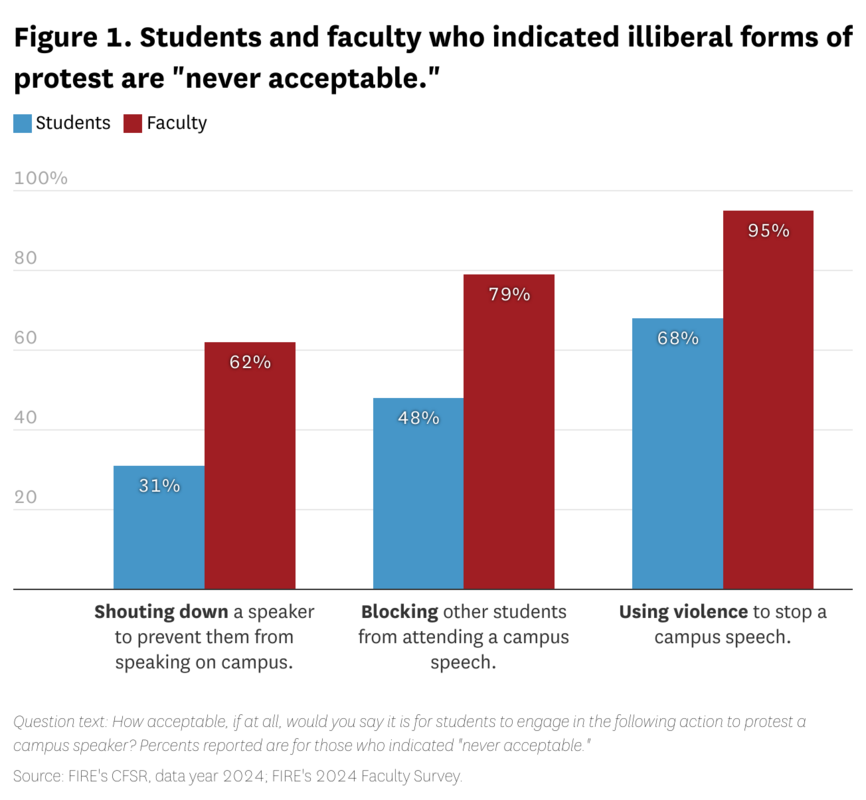

In sum, recent survey data signal faculty concerns about academic freedom protections at U.S. colleges and universities. Over a quarter of faculty members report self-censoring their true opinions and beliefs out of concerns about being disciplined for speaking their minds. Up to 14% of faculty report being disciplined or threatened with discipline by their employer for their speech. Students report less self-censoring but also less support for permitting controversial speakers to share their views on campus.
Key finding #4: Much of the current policy discussion regarding academic freedom centers on institutional neutrality, the concept that higher education institutions should not take official positions on controversies of the day, unless they explicitly pertain to the mission of the institution.
Institutional neutrality is the concept that the university, as a social institution, should not take public positions on political controversies of the day. The concern is based on the expectation that official university positions on political or policy matters will discourage faculty from questioning or criticizing those positions in their teaching, research, and expert advisory roles. This idea stems from a speech given by the first president of the University of Chicago, William Rainey Harper, in 1900.74
The modern case for institutional neutrality comes from the 1967 Kalven Committee Report on the University’s Role in Social and Political Action. Sociologist Harry Kalven, Jr., chaired this committee, which was tasked with providing guidelines for when and whether the University of Chicago could speak as a unit. The report said that the university bears “a heavy presumption” against taking such public stands because “it is a community which cannot resort to majority vote to reach positions on public issues.”75
Legal historians note that the report “seems to have exercised little influence on these contemporaneous debates about the question of institutional neutrality.”76 One legal scholar argued in 1993, “In the climate of law and law schools, political and institutional neutrality is a mirage. We cannot do it.”77
The past few years have seen an increased movement toward adopting official positions on institutional neutrality, starting with Claremont McKenna College in 2018. As of this writing, at least 41 colleges and universities have officially adopted such commitments.78
Since 2023, the debate over institutional neutrality has largely involved university positions and campus protests concerning the Israel–Hamas war.79 In response, several presidents of elite institutions such as Harvard, Yale, Northwestern University, and the University of Virginia formed committees to discuss the issue of institutional neutrality especially, but not exclusively, in light of the Israel–Hamas conflict. Committees at Harvard and Virginia released their institutional neutrality statements, which were cheered by some but criticized as inadequate by others, while other committees continue to deliberate.80
The Kalven report’s findings do not have universal support in academia or among policy organizations. Among faculty, some survey data suggest that most are in support: 66% in a recent survey indicated that colleges and universities should not take positions on political and social issues.81 Outside the academy, the National Association of Scholars, composed of conservative academics, published a report calling institutional neutrality “A False Ideal,”82 arguing that it is unrealistic and ultimately ineffective as a means of protecting academic freedom. In a recent book, Penn education Professor Sigal Ben-Porath writes, “Colleges invite and cherish a diversity of views, but at the same time, they represent certain values. The statements universities make (in response to events on or off campus) are one of the ways universities are able to represent these values.”83
In sum, institutional neutrality is central to the current debate over how universities should protect academic freedom while operating as educational and social institutions. To date, only a modest number of colleges and universities have committed themselves to avoid taking official positions on controversial political and policy matters. The extent to which institutional neutrality commitments operate to protect academic freedom, currently and in the future, remains to be determined.
Understudied issues
More research is needed regarding many aspects of postsecondary academic freedom. While the extensive campus surveys administered regularly by FIRE produce a wealth of information, it would be helpful to see other organizations, individual campuses, or researchers attempt to replicate or augment FIRE’s research. Surveying additional populations, such as administrators or graduate students, would also be of great benefit. The effects of various federal and state policies, such as prohibitions on requiring DEI statements for hiring, on faculty support for and experience of academic freedom remain entirely unknown. Since current students report substantially lower support for academic freedom norms than current faculty do, it is unclear whether the next generation of scholars and higher-education administrators will evidence the same support for academic freedom as does the current generation or whether there will be a narrowing of research topics studied because of increasing ideological homogeneity and self-censorship. Similarly, the effects of adoption of institutional neutrality positions by colleges and universities on academic freedom or on the perceptions or experiences of faculty and students have not been evaluated, nor has there been any investigation of whether institutions genuinely uphold this commitment once it is made. This entire area of postsecondary policy would benefit greatly from more intensive and extensive study.
Conclusion
Core principles of academic freedom have a long history of development and support in the U.S. The principles are motivated by and seek to support the idea that scholars are engaged in a truth-seeking vocation, and, therefore, should face minimal restrictions in their teaching, research, or public statements regarding what they claim to be true. Disputes and controversy center on distinctions between what is protected speech and what is unprotected conduct, as well as what kinds of speech are protected (especially that related to teaching, research, expert advising, public commentary) and what kinds are not (e.g., harassing conduct, accusations, threats). These distinctions are nuanced, and court decisions have not fully clarified where the lines should be drawn. In campus surveys, most faculty report being largely free to express their views and support basic norms of free expression, though over a quarter claim to self-censor and about a seventh report being disciplined or threatened with discipline because of their speech. Students report substantially lower levels of self-censorship and support for norms of free expression than do their professors. While institutional neutrality commitments by universities are viewed by some as effective policies for protecting academic freedom, their actual effects on the culture and actions on campuses remain unknown.
Endnotes and references
-
See Keyishian v. Board of Regents, 385 U.S. 589, 603 (1967). This Supreme Court opinion, written by renowned civil libertarian justice William J. Brennan, is widely considered the apex of the legal system’s insistence on an individual’s right to academic freedom.↩︎
-
Higher Education Act of 1965, Pub. L. No. 89-329, 79 Stat. 1219, 1219 (1965).↩︎
-
N.J. Const., Art. 1, para. 6 & para. 18.↩︎
-
CA Const. Art. 1, para. 2.↩︎
-
See American Association of University Professors (2023). Academic Freedom and the Law, “Internal sources of such contractual obligations may include institutional rules and regulations, letters of appointment, faculty handbooks, and, where applicable, collective bargaining agreements.” Id. at 16.↩︎
-
For the history of American higher education from the colonial era to the late gilded age, see the first three chapters of John Thelin (2011). A History of American Higher Education. Baltimore: The Johns Hopkins University Press. Second Edition.↩︎
-
Daniel Gordon (2023). What Is Academic Freedom? A Century of Debate, 1915-Present. London: Routledge.↩︎
-
American Association of University Professors (1915). 1915 Declaration of Principles on Academic Freedom and Academic Tenure.↩︎
-
Id.↩︎
-
American Association of University Professors (1940). 1940 Statement of Principles on Academic Freedom and Tenure.↩︎
-
Here is a lengthier quotation from the statement, which references a certain duty of professionalism incumbent on professors: “College and university teachers are citizens, members of a learned profession, and officers of an educational institution. When they speak or write as citizens, they should be free from institutional censorship or discipline, but their special position in the community imposes special obligations. As scholars and educational officers, they should remember that the public may judge their profession and their institution by their utterances. Hence they should at all times be accurate, should exercise appropriate restraint, should show respect for the opinions of others, and should make every effort to indicate that they are not speaking for the institution.”↩︎
-
One example is a 1949 report issued by the National Education Association titled “American Education and International Tensions.” This 78-page document was prepared by an Educational Policies Commission, members of which included then Ivy League presidents James B. Conant of Harvard and Dwight D. Eisenhower of Columbia. The report covers many topics, but its aim is to identify new principles for American secondary and higher education that will raise students’ skills and abilities and guide them in becoming productive citizens for the reorganized international political order.↩︎
-
Ellen W. Schrecker (1986). No Ivory Tower: McCarthyism & the Universities. New York: Oxford University Press, Inc.↩︎
-
Davis’s academic mentor at UCLA was Herbert Marcuse, one of the leading postmodernist philosophers of the twentieth century. Marcuse encouraged Davis to pursue novel interdisciplinary study in philosophy, feminism, and colonialism. See Gordon (2023).↩︎
-
Gordon (2023).↩︎
-
Report of the Committee on Freedom of Expression at Yale (1974). The impetus for the drafting of this report is thought to have been both the prolonged protests at many university campuses in the 1960s and early 1970s against the Vietnam War and, specifically at Yale, a campus speech by Stanford physicist William Shockley, who was regarded by many as a racist and a white supremacist.↩︎
-
William Van Alstyne, “The Specific Theory of Academic Freedom and the General Issue of Civil Liberty” (paper presented at a symposium on academic freedom at the University of Texas, Spring 1972). Van Alstyne served as president of the AAUP from 1974 to 1976.↩︎
-
For a fuller discussion, including clashes of academic freedom with the fine arts, see Chapters 5 and 6 of Robert O’Neil (2008). Academic Freedom in the Wired World. Cambridge, Massachusetts: Harvard University Press.↩︎
-
Application of American Tobacco Co., 880 F.2d 1520 (2nd Cir. 1989).↩︎
-
Michael A. Cusumano, professor at the Massachusetts Institute of Technology’s Sloan School of Business, and David B. Yoffie, professor at Harvard Business School.↩︎
-
Cusumano v. Microsoft Corp., 162 F.3d 708 (1st Cir. 1998).↩︎
-
Formerly known as the Foundation for Individual Rights in Education.↩︎
-
Several organizations advocate for academic freedom in international contexts. Scholars at Risk, which was initially attached to the University of Chicago in 1999 before moving to New York University in 2003, publishes an annual “Free to Think” report, highlighting what it considers to be the institutions and academic fields where academic freedom is most precarious. See Scholars at Risk, “Free To Think 2025: Report of the Scholars at Risk Academic Freedom Monitoring Project.”↩︎
-
Foundation for Individual Rights and Expression, “Scholars Under Fire Database.”↩︎
-
Foundation for Individual Rights and Expression, “Campus Deplatforming Database.”↩︎
-
Foundation for Individual Rights and Expression, “Scholars Under Fire: Attempts to Sanction Scholars from 2000 to 2022,” pp. 11–12.↩︎
-
29 Sean Stevens and Chapin Lenthall-Cleary (2025, September 23). Efforts to Silence Scholars Hit Record High. Expression.↩︎
-
354 U.S. 234 (1957).↩︎
-
385 U.S. 589 (1967).↩︎
-
Keith Whittington (2023). Professorial Speech, the First Amendment, and Legislative Restrictions on Classroom Discussions. Wake Forest Law Review 58(463), 487–489.↩︎
-
Sweezy at 249.↩︎
-
Sweezy at 250.↩︎
-
Schrecker (1986).↩︎
-
Keyishian at 603.↩︎
-
Pickering v. Board of Ed. of Tp. High School Dist. 205, Will County, Illinois, 391 U.S. 563 (1968), and Connick v. Myers, 461 U.S. 138 (1982).↩︎
-
See Lawrence Rosenthal (2021). Does the First Amendment Protect Academic Freedom? Journal of College and University Law 46(2), 223-57. Rosenthal concludes that Garcetti “permits an employer to evaluate duty-related speech consistent with pertinent professional norms, not to use it as pretext.” Id. at 255.↩︎
-
See Bonnell v. Lorenzo, 241 F.3d 800 (6th Cir. 2001) (upholding university termination of professor for lewd commentary on English readings and pop culture); Buchanan v. Alexander, 919 F.3d 847 (5th Cir. 2019) (finding for the university where professor made classroom utterances of "profanity, poorly worded jokes, and sometimes sexually explicit jokes"). But, in Cohen v. San Bernardino Valley College, 92 F.3d 968 (9th Cir. 1996), the court found in the professor’s favor and held that his complained-of speech (described as "devil's advocate" positions on topics such as extramarital affairs, rape, pornography, obscenity, and cannibalism) was protected speech.↩︎
-
Brown v. Armenti, 247 F.3d 69 (3rd Cir. 2001) (court ruling in favor of university after professor originally gives student ‘F’ grade, which university president ordered be changed to ‘Incomplete’).↩︎
-
Demers v. Austin, 746 F.3d 402 (9th Cir. 2014) (court applying the Pickering balancing test to Demers’s circulated pamphlet with his suggestions for restructuring the school at which he taught and ruling in Demers’s favor), Kurtz v. Vickrey, 855 F.2d 723 (11th Cir. 1988) (court ruling that some of the professor-plaintiff’s speech on university salaries and finances was protected under a balancing test and that other speech was unprotected).↩︎
-
236 F.3d 888 (7th Cir. 2001).↩︎
-
In response to Wozniak’s invoking his right to due process under the Fourteenth Amendment, Judge Frank Easterbrook colorfully rejoined, “Why hold a hearing when the insubordination is conceded?” Id. at 890.↩︎
-
Heim v. Daniel, 81 F.4th 212 (2nd Cir. 2023).↩︎
-
Renken v. Gregory, 541 F.3d 769 (7th Cir. 2008).↩︎
-
Emergency Coalition to Defend Educational Travel v. U.S. Dept. of the Treasury, 545 F.3d 4 (D.C. Cir. 2008).↩︎
-
Foundation for Individual Rights and Expression, “Scholars Under Fire Database.”↩︎
-
Nathan Honeycutt and Sean T. Stevens (2025). Sanctioned Scholars: The Price of Speaking Freely in Today’s Academy. Foundation for Individual Rights and Expression.↩︎
-
Porter v. Board of Trustees of North Carolina State University, 72 F.4th 573 (4th Cir. 2023). The district court record included several instances of a lack of decorum on Porter’s part, through emails and meetings with colleagues. The triggering incident appears to have been when Porter described the Association for the Study of Higher Education as a “woke joke” at whose conference he wouldn’t “learn new things.” Id. at 578–79. The administration removed Porter from his Program Area, and Porter claimed that he was barred from attending department events such as an orientation, a cookout, and a staff retreat in which he had previously been allowed to take part. Id. at 580.↩︎
-
Porter, 72 F.4th at 583.↩︎
-
605 F.3d 703 (9th Cir. 2010). Note that this case arose from a hostile environment Title VII claim brought by a group of Hispanic employees against the community college district. They alleged that Professor Walter Kehowski’s conduct created a racially hostile working environment and that the district had failed to prevent further harassment once it became aware of Kehowski’s emails.↩︎
-
According to the Ninth Circuit’s opinion, Kehowski referred to Día de la raza, the Hispanic replacement holiday for Columbus Day, as “racist,” shared an article that promoted a theory that Native Americans committed a genocide against the first white inhabitants of North America, and mused that should Americans not “pull ourselves out of the multicultural stupor, another culture with some pretty unsavory characteristics (here, here, and here) will dominate (here, here, and here).” Id. at 705–06.↩︎
-
Rodriguez, 605 F.3d at 708.↩︎
-
Rodriguez, 605 F.3d at 710.↩︎
-
The law is codified at Fl. St. § 1012.977. It requires any state university employee to “disclose and receive a determination that the outside activity or financial interest does not affect the integrity of the state university of entity.” An employee who fails to disclose such activities to “shall be suspended without pay pending the outcome of an investigation […] Upon conclusion of the investigation, the university or entity may terminate the contract of the employee.” Id.↩︎
-
See Michael Wines, “Florida Bars State Professors From Testifying in Voting Rights Case,” The New York Times, October 29, 2021.↩︎
-
President Kent Fuchs issued a brief statement to the university community affirming a commitment to academic freedom. See President Kent Fuchs and Joe Glover, “Message from President Fuchs and Provost Glover,” University of Florida.↩︎
-
Lindsay Ellis, “U. of Florida Doctor Says Administrators Blocked Him From Participating in Lawsuits About Masking,” The Chronicle of Higher Education, November 2, 2021.↩︎
-
Austin v. University of Florida Board of Trustees, 580 F.Supp.3d 1137 (N.D. Fla. Jan. 21, 2022) (finding plaintiffs likely to succeed on the merits that the conflicts policy was an unconstitutional prior restraint on speech and that it discriminated based on the speakers’ viewpoint).↩︎
-
“The IFA amended the Florida Educational Equity Act (FEEA) to prohibit ‘training or instruction that espouses, promotes, advances, inculcates, or compels . . . student[s] or employee[s] to believe [eight specified concepts].’ § 1000.05(4)(a), Florida Statutes (2022).” See Pernell v. Florida Board of Governors of the State University System, 641 F.Supp.3d 1218, 1231 (N.D. Fla. Nov. 17, 2022).↩︎
-
Pernell.↩︎
-
Pernell v. Florida Board of Governors of the State University System, No. 22-13992 (11th. Cir., Mar. 16, 2023).↩︎
-
Some contend that the growth of university administrative departments that review bias reports and/or promote DEI programming has worsened the speech climate. Distinguished Harvard Law professor Jeannie Suk Gersen puts the issue thusly:
What many people perceive as creating a hostile environment in 2022 is different from what they would have understood as such only ten years earlier. We’ve seen the significant growth of university bureaucracies including those dedicated to promoting and enforcing university antidiscrimination policies, through training, investigation, adjudication, and discipline, for reported and alleged incidents. And offices of diversity and inclusion related to this work have grown and become fixtures of university administrations in recent years. The work of those offices necessarily disfavors speech that is discriminatory, and their orientation and training of the university community cannot reasonably be expected to be content neutral since part of their mandate is to be against discriminatory speech. Realistically, what people experience, report, and expect to be disciplined as discrimination or harassment based on their training and socialization affects what speech they consider illegitimate. And the more speech that is perceived as discriminatory, the more contests there are over the contracting space wherein people may express views without fearing discipline. It is therefore not surprising to see what we are now seeing: that training and discipline on discrimination, harassment, and bullying overseen by diversity and inclusion offices are coming into conflict with academic freedom. We see increasing clashes that look like fights between antidiscrimination commitments and principles of academic freedom. Jeannie Suk Gersen (2022). Academic Freedom and Discrimination in a Polarizing Time. Houston Law Review 59(4), 792–94.↩︎
-
Ashley P. Finley & Hans-Jorg Tiede (2025). Academic Freedom and Civil Discourse in Higher Education: A National Study of Faculty Attitudes and Perceptions; Matthew J. Goodwin (2022) Is Academic Freedom Under Threat? Legatum Institute; Nathan Honeycutt (2024a). Silence in the Classroom: The 2024 FIRE Faculty Survey Report. Foundation for Individual Rights and Expression.↩︎
-
Honeycutt (2024a).↩︎
-
Id.↩︎
-
Paul Lazarsfeld and Wagner Theilens, Jr. (1958). The Academic Mind: Social Scientists in a Time of Crisis. The Free Press.↩︎
-
Nathan Honeycutt, Sean T. Stevens, and Eric Kaufmann (2023). The Academic Mind in 2022: What Faculty Think About Free Expression and Academic Freedom on Campus. Foundation for Individual Rights and Expression.↩︎
-
Goodwin (2022); Honeycutt (2024a).↩︎
-
Honeycutt (2024a).↩︎
-
Id.↩︎
-
Nathan Honeycutt (2024b). Faculty Evaluations of DEI Statements for Academic Hiring.↩︎
-
Sean T. Stevens (2025). 2026 College Free Speech Rankings: What Is the State of Free Speech on America’s College Campuses? Foundation for Individual Rights and Expression.↩︎
-
Honeycutt (2024a).↩︎
-
Stevens (2025).↩︎
-
The transcript of Harper’s speech appears in The Chicago Canon (2023). Edited by Tony Banout and Tom Ginsburg. The University of Chicago. This book was “published for the Inauguration of the University of Chicago Forum for Free Inquiry and Expression,” a center that “promotes the understanding, practice, and advancement of free and open discourse at the University of Chicago and beyond.” The book catalogues major speeches and addresses from several University of Chicago presidents and statements such as the Kalven Report and the Report of the Committee on Freedom of Expression (often referred to as “The Chicago Principles”).↩︎
-
Report on the University’s Role in Social and Political Action, 1 Record (No. 1) (November 11, 1967). One year before the report’s release, the university’s campus was home to student protests opposing both the Vietnam War draft and investment in apartheid South Africa. See Adrienne Lu, “The Apolitical University” The Chronicle of Higher Education, December 2, 2022. ↩︎
-
Robert Post, “The Kalven Report, Institutional Neutrality, and Academic Freedom” in Revisiting the Kalven Report: The University’s Role in Social and Political Action (Keith E. Whittington and John Tomasi, eds. Johns Hopkins Press, Forthcoming).↩︎
-
David Barnhizer (1993). "Freedom to Do What? Institutional Neutrality, Academic Freedom, and Academic Responsibility." Journal of Legal Education 43(3), 356.↩︎
-
Foundation for Individual Rights and Expression (n.d.). Adoptions of an Official Position of Institutional Neutrality.↩︎
-
Media organizations covering the campus protests noted that many of them occurred at private universities on the East and West Coasts, along with a few state flagship campuses (e.g., “Scenes from the Student Protests Churning Across the Country” The New York Times, April 30, 2024).↩︎
-
The cochairs of Harvard’s Institutional Voice Working Group published an opinion-editorial in The New York Times the same day that the university released the committee’s report. See Noah Feldman and Alison Simmons, “Harvard Should Say Less. Maybe All Schools Should.” The New York Times, May 28, 2024. Chancellor Diermeier criticized the Working Group in part because its report did not state that university endowment investment and divestment decisions can never be made with respect to political preferences. “Harvard,” supra note 11. Views of the University of Virginia’s institutional neutrality statement are summarized in Mike Mather (2024, September 10). “UVA Adopts ‘Position of Neutrality’ When Considering Commenting on Events.” UVAToday.↩︎
-
Honeycutt (2024a).↩︎
-
Peter Wood, “The Illusion of Institutional Neutrality” National Association of Scholars, 2024.↩︎
-
Sigal Ben-Porath (2023). Cancel Wars: How Universities Can Foster Free Speech, Promote Inclusion, and Renew Democracy. Chicago, Illinois. University of Chicago Press.↩︎
Suggested Citation
Wolf, Pat, Alex Wolf and Nathan Honeycutt (2026). "Academic Freedom," in Live Handbook of Education Policy Research, in Douglas Harris (ed.), Association for Education Finance and Policy, viewed 09/22/2026, https://livehandbook.org/higher-education/miscellaneous/academic-freedom/.