College Closures
Key Findings
- Key Finding 1
A sizable portion of American higher education institutions exhibit at least some signs of financial distress that could eventually lead to closure. Between fifteen and twenty percent of colleges have posted financial losses in at least five of the last ten years.
- Key Finding 2
The number of closures has varied over time, with a spike in for-profit closures appearing in the mid-to-late 2010s and increased private nonprofit closures in more recent years. Approximately fifty colleges per year have closed in the 2020s, representing approximately one percent of all colleges each year, and the majority of those closures are small for-profit institutions.
- Key Finding 3
Attending a college that closes is associated with reduced levels of educational attainment for students. There is also the potential for negative effects for alumni, employees, and local communities, although more research is needed in the higher education context.
- Key Finding 4
Multiple factors are associated with closure, and it is possible to identify colleges that have a higher risk of closure. These factors include declining enrollment, consistently posting operating losses, declining cash on hand, and being placed on additional oversight by the U.S. Department of Education. However, many colleges that exhibit substantial risk continue to operate.
- Key Finding 5
Mergers, acquisitions, and consolidations are a possible way to avoid closure, but research on their effectiveness is limited, and these have been relatively rare events outside of public higher education.
Introduction
As colleges and universities continue to face rising financial pressure, the topic of college closures has received increased attention from policymakers and the public. College closures are important because they have serious implications for students, alumni, community members, and taxpayers. Students who attend a college that closes are less likely to complete the credential they were pursuing. Since this increases the probability of loan discharge, taxpayers thus face higher costs. Sudden closures are of particular concern because colleges can no longer help their students transfer easily and employees often have difficulties finding similar jobs. Moreover, as relatively large employers, especially in rural areas, the closure of colleges likely has adverse effects on local communities.
Colleges that close are generally very small, and few students are affected in most years. However, a sizable group of private nonprofit and for-profit colleges serving thousands of students each year faces a level of financial distress that puts them at risk of closing in the next several years. This chapter summarizes research on college closures over the last two decades, the implications of closure for students and employees, factors associated with closures, and strategies that colleges have used to mitigate financial distress and avoid closing.
Evidence
Key finding #1: A sizable portion of American higher education institutions exhibit at least some signs of financial distress.
Between fall 2011 and fall 2022, the number of students enrolled at degree-granting institutions in the United States fell from 21 million to 18.6 million—a decline of more than ten percent.1 Tuition and fees represented 22% of the nearly $800 billion in total higher education revenues in Fiscal Year 2023, with private institutions and less-research-focused institutions typically relying on student dollars to fund a larger share of their budgets.2 Additionally, enrollment declines during the 2010s and early 2020s have been concentrated at broad-access institutions, such as community colleges and non-selective four-year colleges, while flagship public universities and selective private institutions have often seen enrollment gains.3
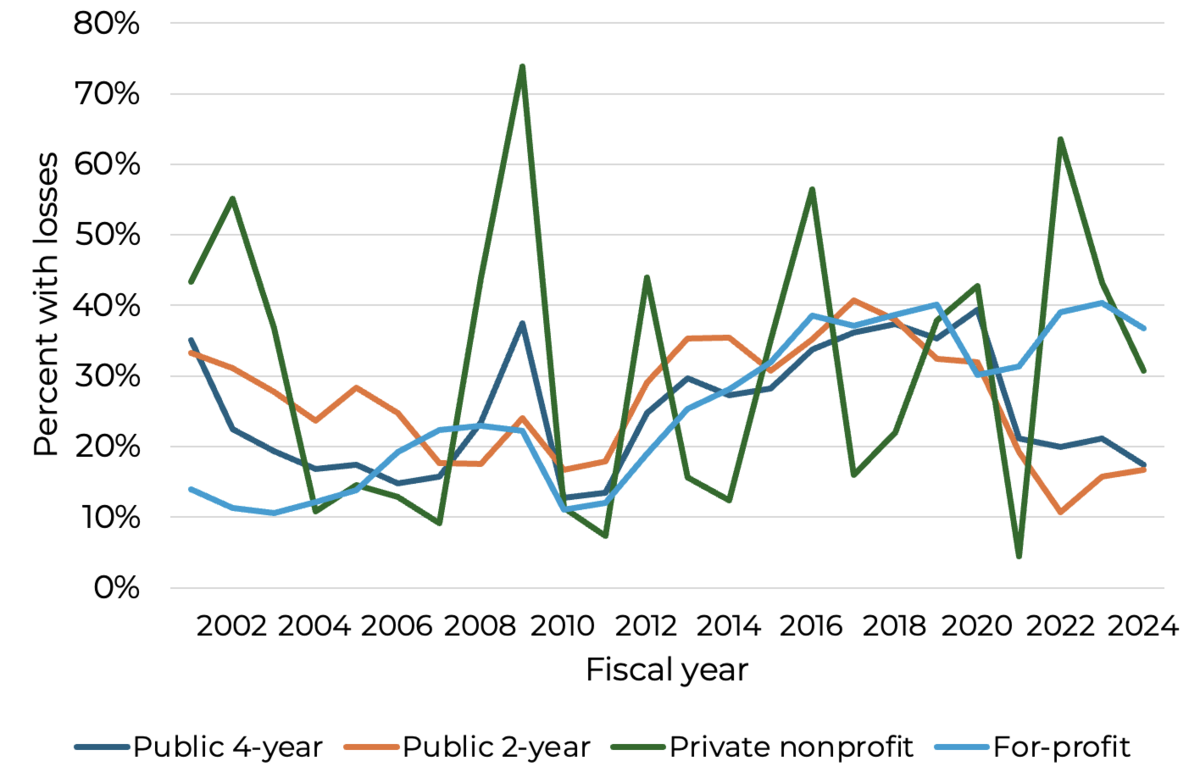
Figure 1 shows the share of colleges by sector posting financial losses in a given fiscal year between Fiscal Years 2001 and 2024. The results for private nonprofit colleges are volatile due to investment returns increasing revenue in good years and decreasing revenue in bad years. Excluding years with unusual stock market swings, the late 2010s saw the highest rate of overall losses across all of higher education, with expenses exceeding revenues at nearly four in ten institutions. Fiscal Year 2021 (the height of the coronavirus pandemic) saw the lowest share of losses since before the Great Recession thanks to a large influx of federal pandemic relief dollars. Public colleges fared well in the post-pandemic era due to strong state funding, but approximately half of all private nonprofit institutions posted losses in Fiscal Years 2022 and 2023 after just five percent did so in Fiscal Year 2020 thanks to federal pandemic relief funds.
- Figure 1
Trends in financial losses by sector and year

Key finding #2: The number of closures has varied over time, with a spike in for-profit closures in the mid-to-late 2010s and increased private nonprofit closures in more recent years.
The authoritative source to track college closures over time is the Office of Federal Student Aid’s Weekly Closed School Search file, which includes a comprehensive list of closures dating back to the late 1980s.4 This dataset only includes institutions receiving federal financial aid under Title IV of the Higher Education Act, which excludes many small for-profit colleges that do not participate in federal aid programs.5 Federal data thus likely represent a significant understatement in the number of actual closures each year. However, having an accurate number of closed institutions receiving federal financial aid is crucial because students who are currently attending a college that closes can have their loans discharged, shifting the financial burden to taxpayers.6
Figure 2 shows trends in the number of main campus closures by sector and year among institutions receiving federal financial aid between 1996 and 2025. 7 Over the three-decade period, 1,803 institutions closed (approximately one in five institutions that ever received federal financial aid during this time), and these are disproportionately very small colleges. Two years prior to closure, the typical closed institution enrolled approximately 200 students.8 More than two-thirds of the closures were for-profit institutions. For-profit closures have ebbed and flowed over time, with there being a relatively low number of closures throughout much of the 2010s, followed by a sharp increase in the mid-2010s.
The mid-2010s increase in closures was likely driven by factors other than immediate financial distress. Some can be attributed to increased accountability pressures implemented by the Obama administration, including a sharp uptick in the number of institutions placed on heightened cash monitoring (HCM, a federal policy that primarily identifies colleges facing financial challenges) and an effort to release program-level data on for-profit colleges’ outcomes that induced some colleges to close their doors due to new information on poor outcomes.9 The mid-2010s also saw the collapse of several large for-profit chains such as ITT Technical Institute and Corinthian Colleges due to actions taken by the Obama administration, instances in which tens of thousands of students were affected instead of hundreds.10
- Figure 2
Number of closures by sector and year
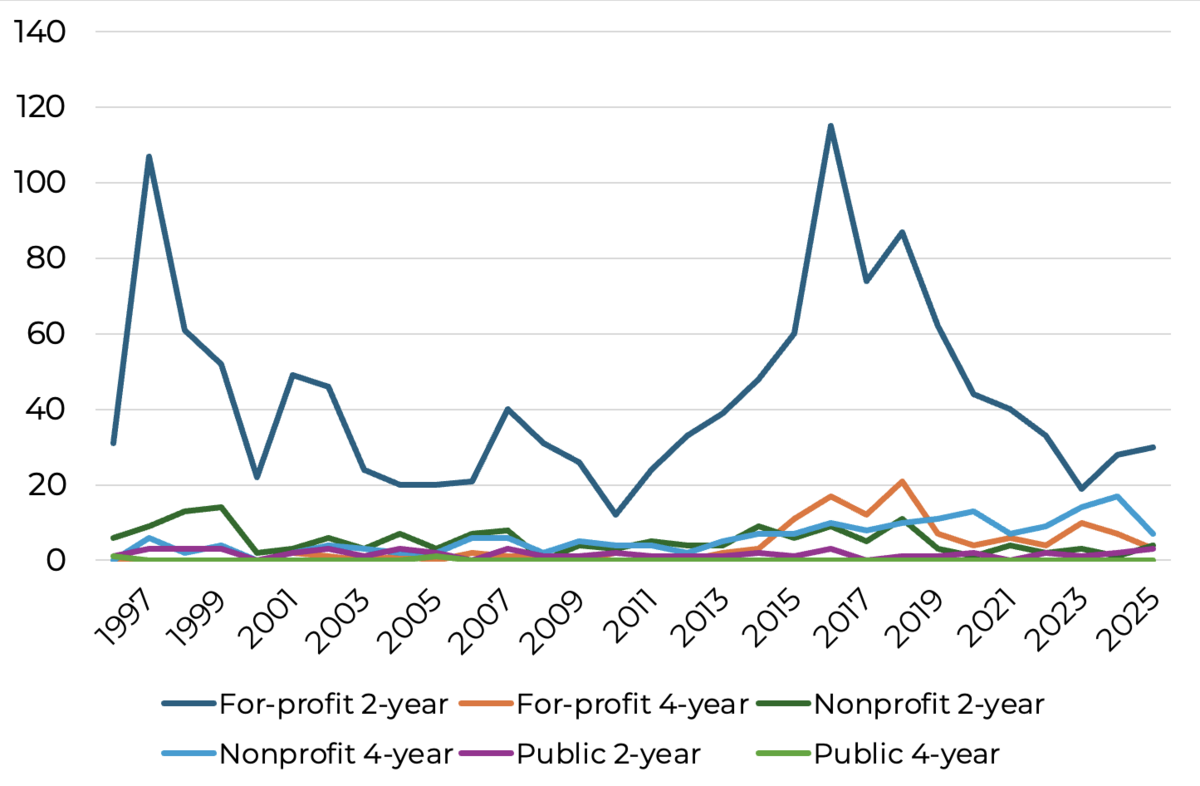

While for-profits represent most of the colleges that have shut their doors, the closure of four-year private nonprofit colleges has attracted the vast majority of public attention. Closures in this sector have been relatively uncommon over time, with an average of six colleges closing each year out of approximately 2,000 institutions in the sector (an approximately 0.3% annual closure rate). However, the number of closures has increased over time: An average of three colleges closed each year between 1996 and 2013, compared to an average of ten between 2014 and 2025 (a 0.5% annual closure rate). The years 2023 and 2024 saw the most closures (14 and 17, respectively) before closures fell to seven in 2025.
There are two reasons that public institutions rarely close. First, the approximately $110 billion in appropriations that states provide to public colleges and universities represents an additional revenue source beyond tuition and fees that private institutions lack.11 This means that public institutions can stay open in some fashion almost regardless of their enrollment changes. Second, the governance structure of public higher education, in which trustees are primarily appointed by elected officials or run for the positions in public elections, makes closure decisions exceedingly difficult. Few legislators are willing to allow an institution in their district to close.
No public four-year institution has closed since 2005, and fewer than two public two-year institutions closed each year over the past three decades. Most of the closed two-year institutions have been special-focus institutions instead of traditional community colleges. The 2024 closure of Eastern Gateway Community College in Ohio was an outlier after the institution lost a key revenue source (a free online college program for union members and their families) under pressure from the U.S. Department of Education, causing the institution to plunge into severe distress.12
Overall, college closures are a very rare occurrence outside the for-profit sector, and only between five thousand and fifty thousand of the twenty million (0.03%) students enrolled in American higher education are directly affected each year.13 However, because there are concerns that the number of closures may increase over time due to the financial headwinds facing the sector and given the negative implications of closure for all affected constituents, college closures continue to be an item of concern.
Key finding #3: Attending a college that closes is associated with reduced levels of educational attainment for students. There are also potential negative effects for alumni, employees, and local communities, although more research is needed.
College closures have the potential to be incredibly disruptive to students, alumni, employees, and local communities. If students choose to continue their education, they have to transfer to a new institution, which can be particularly challenging if the closing institution shutters suddenly without providing support and assistance such as reaching teach-out agreements with other institutions. Even closures that are announced months in advance can be challenging for employees, particularly for those who have limited opportunities within their commuting zone. Local communities, particularly in rural areas, may struggle to replace a sizable employer—and one that trains workers for other local industries—that has a substantial real estate footprint with few opportunities for reusing facilities.
One important factor that may influence students’ future outcomes is whether a closure is planned and announced with sufficient notice to make transferring institutions without stopping out easier. Defining an orderly closure as one in which there is an executed teach-out plan where partner institutions agree to take on students and the closing institution keeps student records, approximately 70% of institutional closures over a two-decade period were defined as orderly; however, because several large for-profit closures (such as ITT Tech and Corinthian) were abrupt, only 30% of students enrolled at closure experienced an orderly closure.14 Students enrolled at a college facing an abrupt closure continued their studies elsewhere at substantially lower rates than students who experienced an orderly closure.15
It is difficult to causally determine the effects of college closures on students, employees, and local communities because closures are not randomly assigned and generally do not allow for the use of quasi-experimental methods. One study used matching techniques at the student and institution levels to estimate that students who experience a closure are about eight percent less likely to complete a credential of at least the same level that they were initially pursuing, although more students successfully completed shorter-term programs at other institutions.16 Research examining for-profit colleges that lost federal financial aid access (a proxy for closure) found that approximately two-thirds of enrollment losses at sanctioned institutions were absorbed by community colleges; however, there are not always locally accessible in-person public options for four-year degrees if a baccalaureate-granting institution closes.17
There is no empirical research on the effects of college closures on employees, although there are anecdotes of the difficulties that employees face in finding similar positions, and research on the effects of firm closures in other industries shows negative effects.18 A frequent challenge with closures is the timing of announcements. For example, if a college announces in February that it will be closing as of the upcoming May or July, students may have sufficient time to transfer to a new institution before the fall term begins. However, because hiring for full-time positions generally begins nearly a year in advance of when a new hire starts, many faculty searches will have already closed by the time that employees know they need to find a job. The same concern also holds for professional staff positions that have highly specialized skills within higher education, such as enrollment management and student affairs.
Colleges and universities are recognized as being anchor institutions for their local communities, along with hospitals and K–12 schools.19 Approximately 40,000 staff members were employed two years prior to closure at institutions that closed between 2003 and 2023, and that number is substantially larger when looking several years out, as institutions made budget cuts in an unsuccessful effort to survive.20 Losing employee salaries and the multiplier effect of having students living and working in local communities—particularly among private nonprofit colleges—further strains local tax bases. Furthermore, although nonprofit colleges do not pay property taxes, it can be difficult to find a buyer for purpose-built educational facilities due to backlogs of deferred maintenance and limited demand for real estate in small towns. This results in some campuses sitting empty for years, creating economic development challenges in their communities.21
Finally, alumni could also be affected if their alma mater closes. In the case of an orderly teach-out agreement, academic records are transferred to another institution, and alumni can prove that they graduated. However, if a college suddenly closes its doors without a plan in place for someone to adopt the records, obtaining transcripts can be difficult. Another concern is that as the name of a closed institution fades from the region’s memory, the value of that credential could be negatively affected.
Key finding #4: Multiple factors are associated with closure, and it is possible to identify colleges that have a higher risk of closure. However, many colleges that exhibit substantial risk continue to operate.
There are hundreds of colleges in the United States with at least some level of financial weakness, but it is challenging to identify exactly when a particular college will close based on publicly available information. Ultimately, the tipping point for many colleges comes when they no longer have enough cash on hand to make payroll. This situation can develop slowly over a period of months or years, or it can be triggered by factors such as lenders refusing to renegotiate bond payments or a college facing sudden sanctions from a government agency or accreditor.
The stakes for correctly identifying a college closure are high. Failing to identify a college that does not have the resources to stay open means that students and employees are unable to consider other opportunities in a timely manner. On the other hand, incorrectly predicting that a college will close when it would have had enough money to remain solvent could become a self-fulfilling prophecy; simply stating that a college is at risk may do enough reputational damage that it will be forced to close. This is why previous efforts by the private sector and government bodies to publicly label colleges as being at risk of closure have been vociferously opposed by institutions, to the point of threatening lawsuits.22
Government agencies use several metrics to identify colleges that are at risk of closure. The federal government primarily relies on placing colleges on HCM, which requires colleges to provide additional documentation before receiving federal financial aid, as its key accountability provision. Institutions are typically placed on HCM for having a low financial responsibility score, which broadly evaluates a college’s financial position, but institutions can also be placed on HCM for governance or accreditation issues.23 Each state has an authorizing agency that is responsible for overseeing private colleges, and they typically rely on audited financial statements and student complaints to identify colleges that should receive additional scrutiny.24
A growing literature uses regression-based techniques to identify factors associated with college closures. Factors linked with a higher probability of closure in existing research include being a historically Black college, women’s college, or located in a rural area and having lower faculty salaries, lower tuition, and smaller endowments.25 However, these studies do not fully consider trends over time, which can be a substantial driver of closure as financial pressures mount.
A recent analysis predicting college closures used machine learning models to help identify relationships among variables that could be associated with closures and to use data missingness as a factor predicting closures.26 By examining approximately two decades of closures, the models identified a number of variables that jointly predicted a college closing within three years. Some of the key factors included the U.S. Department of Education’s financial responsibility composite score, changes in enrollment, revenue, and staffing, operating margin, unrestricted assets, and days of cash on hand. This complete model more accurately predicted closure than using linear regressions alone and captured more closures by effectively using missingness as a variable.
Using machine learning to predict college closures can identify schools that are at a higher risk of closure, as 52 of the 100 riskiest institutions in the above model closed within three years.27 However, there are several reasons that even these sophisticated and data-rich models cannot perfectly identify when—or whether—a college will close. These include changes that have been made to institutional actions since data were released, idiosyncratic positive or negative shocks, and the influence of governance-related factors that have not been systemically explored in research. To provide an example of the resiliency of private nonprofit colleges, approximately two-thirds of the institutions identified as “invisible” and having “limited resources” in 1972 remained open more than four decades later.28 It is straightforward to identify institutions worth monitoring, but many of them will continue to defy the odds.
Key finding #5: Mergers, acquisitions, and consolidations are a possible way to avoid closure, but research on their effectiveness is limited.
One possible way to reduce the number of college closures is for struggling institutions to pursue a merger with another institution. While these are often called mergers, they typically function as an acquisition in which a larger institution assumes control of a smaller institution and often rebrands or eventually closes the smaller campus.
According to an analysis of Federal Student Aid data on college closures, there were 521 mergers or consolidations between 2000 and 2025 (affecting approximately seven percent of all institutions), with just over half of these occurrences being in the for-profit sector and exhibiting a notable peak in the early 2010s.29 This number includes systems undergoing administrative consolidations without changing operations, as well as what the general public typically considers to be mergers—two institutions with similar market positions joining forces to become a larger and stronger institution.
Similar to closures, mergers and acquisitions disproportionately gain public attention when they are in the private nonprofit or public sectors. Some examples include Boston University acquiring Wheelock College and incorporating it into its education school, Northeastern University acquiring Mills College as a branch campus across the country, and the University of Tennessee System acquiring Martin Methodist College and converting it into a regional public university.30 A rare example of a merger of near equals occurred in 2017, when Philadelphia University and Thomas Jefferson University merged to take advantage of their strengths in different areas.31
Other private institutions, such as Marymount California University and Notre Dame College of Ohio, closed after being unable to agree to a merger before running out of funds.32 Public and private nonprofit institutions have also acquired for-profit colleges, with the University of Arkansas, University of Arizona, and Purdue University purchasing Grantham University, Ashford University, and Kaplan University, respectively.
Public higher education has also seen several notable consolidation efforts, with the goals typically being improved student success and administrative efficiencies. Examples include the University System of Georgia, the University of Wisconsin System, and the Pennsylvania State System of Higher Education; a total of 22 states or systems attempted consolidation efforts between 2007 and 2020, although not all of them were implemented.33 Very few of these consolidation initiatives have involved closing campuses, although seven of the 13 former University of Wisconsin Colleges that were placed under the oversight of individual four-year institutions in 2019 have since closed their physical campuses or have announced an upcoming closure.34
There is limited research on the effectiveness of mergers, acquisitions, and consolidations. One study found evidence that mergers in the nonprofit sector are associated with increased tuition prices, suggesting that mergers can increase market power.35 Research examining consolidation in Georgia showed increased student retention and on-time completion rates while shifting spending from student services to academic support.36
Conclusion
The financial pressures facing higher education are likely to intensify over the next several years given an unfavorable demographic outlook in much of the country, challenges to federal support, and increasingly tight state budgets. Even wealthy research institutions, which have been largely immune to challenges facing the rest of higher education, are likely to face pressures due to reductions in international student enrollment and federal research funding.
The baseline risk of college closures is rising for lesser-resourced private institutions as revenues are increasingly challenged. However, institutions are increasingly taking actions to cut costs and balance budgets with reduced enrollment numbers. These efforts include scrutinizing new investments, shuttering underused facilities, and cutting low-enrollment programs and majors. These efforts are pursued by both small private colleges trying to fend off closure and large research universities grappling with the new financial reality.
While cost-cutting initiatives are rarely popular among employees and students, they represent a potential tool to help colleges survive in challenging times. More research is needed on the effects of these cuts on financial viability and student outcomes, as more institutions will be affected by cuts than closures. Research from K–12 education suggests that school consolidation reduces costs while not affecting key educational outcomes, but the null findings on educational attainment may not apply to higher education because of the greater distance between colleges in much of the country.37 Studying the financial effects of closures and mergers is an important area for future research.
Endnotes and references
-
National Center for Education Statistics. 2026. Fall Enrollment: Total Enrollment, Selected Years.↩︎
-
Author’s calculations from summary Integrated Postsecondary Education Data System (IPEDS) finance data..↩︎
-
Cooper, P. 2025. Learning with Their Feet: Student Enrollment Trends in Postsecondary Education by College Quality. American Enterprise Institute↩︎
-
Office of Federal Student Aid. 2026. Weekly Closed School Search File.↩︎
-
There is no national estimate of the number of colleges that do not receive federal financial aid. Cellini and Goldin (2014) used data from five states in the late 2000s to estimate that nearly half of all for-profit colleges and one-fourth of students at for-profit institutions were not Title IV-eligible. Cellini, S. R., and C. Goldin. 2014. Does Federal Student Aid Raise Tuition? New Evidence on For-Profit Colleges. American Economic Journal: Economic Policy 6(4): 174–206.↩︎
-
Office of Federal Student Aid. 2026. Closed School Discharge..↩︎
-
The Federal Student Aid database, which contains information on each individual branch campus that has closed over nearly four decades, includes more than 22,000 closures between the mid-1980s and January 2026. While tens of thousands of educational sites have ceased operations, many of these closures are outposts of main campuses where only a limited set of programs were ever offered, and students had opportunities to continue their studies at the same institution. For example, in May 2025, the database includes two closures at Southwest Minnesota State University related to their master’s in education programs. One of the addresses is listed as a “Holiday Inn & Express,” suggesting a short-term educational site. The way to track closures of entire institutions is to use the Office of Postsecondary Education identification number (OPEID). If an OPEID ends in 00, it is typically a main campus closure (representing the entire institution closing); an OPEID ending in 01 through 99 reflects a branch campus, which have the most substantial impacts on students, taxpayers, and local communities. A few institutions (such as the University of Phoenix) have operated at more than 100 sites over time, which results in a branch campus being given a new OPEID ending in 00. Those are relatively rare occurrences, however. I used main closures with OPEIDs ending in 00 in my analyses, excluding the edge cases above.↩︎
-
Kelchen, R., D. Ritter, and D. A. Webber. 2024. Predicting College Closures and Financial Distress. Federal Reserve Bank of Philadelphia Working Paper 24-20.↩︎
-
Kelchen, R. 2022. Did Gainful Employment Regulations Result in College and Program Closures? Education Finance and Policy 17(3), 454–478; Kelchen, R. 2025. Examining the Relationship Between Institutional Financial Stress and Student Enrollment. Journal of Postsecondary Student Success 4(3).↩︎
-
Johnson, A. 2015. Corinthian Colleges Shuts Down, Ending Classes for 16,000 Overnight. NBC News. April 26. Smith, A. 2016. The End for ITT Tech. Inside Higher Ed. September 7.↩︎
-
Kunkle, K., & Burns, R. (2025). State higher education finance: FY 2024. State Higher Education Executive Officers Association. https://shef.sheeo.org/wp-content/uploads/2025/05/SHEEO_SHEF_FY24_Report.pdf.↩︎
-
Coffey, L. (2024, May 17). Embattled Eastern Gateway Community College to close. Inside Higher Ed. https://www.insidehighered.com/news/quick-takes/2024/05/17/embattled-eastern-gateway-community-college-close.↩︎
-
Kunkle, K., and R. Burns. 2025. State Higher Education Finance: FY 2024. State Higher Education Executive Officers Association.↩︎
-
Burns, R., L. Brown, K. Heckert, D. Weeden, H. S. Kim, B. Randolph, A. Pevitz, S. Karamarkovich, and J. Causey. 2022. A Dream Derailed? Investigating the Impacts of College Closures on Student Outcomes. State Higher Education Executive Officers Association and National Student Clearinghouse Research Center.↩︎
-
Ibid.↩︎
-
Burns, R., E. Bryer, K. Heckert, D. Weeden, and L. Brown. 2023. A Dream Derailed? Investigating the Causal Effects of College Closures on Student Outcomes. State Higher Education Executive Officers Association.↩︎
-
Cellini, S. R., R. Darolia, and L. J. Turner. 2020. Where Do Students Go When For-Profit Colleges Lose Federal Aid? American Economic Journal: Economic Policy 12(2): 46–83.↩︎
-
Carlson, B. 2024. My University Closed. Now What? The Chronicle of Higher Education. July 1; Suriano, J. N., T. Ward, and J. C. Slichko. 2025. Our College Closed: Advice for Navigating Professional Deaths and Rebirths. Inside Higher Ed. April 8.↩︎
-
Harkavy, L., and H. Zuckerman. 1999. Eds and Meds: Cities’ Hidden Assets. Brookings Institution. Harker, P. T., D. Diamond, and D. Reed. 2022. Anchor Impact: Understanding the Role of Higher Education and Hospitals in Regional Economies. Federal Reserve Bank of Philadelphia.↩︎
-
Kelchen, et al., 2024.↩︎
-
Gottlieb, J. 2025. When a College Dies, Who Gets the Campus? Bloomberg. September 18.↩︎
-
Fain, P. 2019. Private Conversations About Private College Closures. Inside Higher Ed. November 18; Osei, Z. 2019. Massachusetts Wants to Regulate Private Colleges That Might Close. Is That a Good Idea? The Chronicle of Higher Education. April 16.↩︎
-
Kelchen, 2025.↩︎
-
Ness, E., S. Baser, and M. Dean. 2021. State Authorization Landscape and Process: An Inventory, Classification, and Analysis. State Higher Education Executive Officers Association.↩︎
-
Britton, T., R. M. Rall, and F. Commodore. 2023. The Keys to Endurance: An Investigation of the Institutional Factors Related to the Persistence of Historically Black Colleges and Universities. The Journal of Higher Education 94(3): 310–332; Porter, S. R., and T. J. Ramirez. 2009. Why Do Colleges Fail? An Analysis of College and University Closings and Mergers, 1975–2005; Zapp, M., and C. Dahmen. 2025. Live and (Let) Die—Shifting Legitimacies and Organizational Mortality in American Higher Education, 1944–2018. Social Problems 72(1): 172–190.↩︎
-
Kelchen, et al. 2024.↩︎
-
Ibid.↩︎
-
Tarrant, M., N. Bray, and S. Katsinas. 2018. The Invisible Colleges Revisited: An Empirical Review. The Journal of Higher Education 89(3): 341–367.↩︎
-
Castrejon, A. 2025. College Mergers, Consolidations, and Acquisitions. State Higher Education Executive Officers Association.↩︎
-
Aoun, J. E., and E. L. Hillman. 2022. Mills and Northeastern Finalize Merger to Build Innovative Future. Northeastern University. June 30; Jahnke, A. 2017. BU-Wheelock Merger Will Create New College. BU Today. October 11; University of Tennessee System. 2021. Board of Trustees Votes to Acquire Martin Methodist College. June 25.↩︎
-
Chatlani, S. 2017. Philadelphia University, Thomas Jefferson University to Merge Effective July 1. Higher Ed Dive. June 29.↩︎
-
Burke, L. 2024. Notre Dame College to Close After Spring Semester. Higher Ed Dive. March 1; Lederman, D. 2022. Marymount California University Will Close. Inside Higher Ed. April 22.↩︎
-
Kurzweil, M., M. Andrews, C. B. Hill, S. Jones, J. Radecki, and R. C. Schonfeld. 2021. Public College and University Consolidations and the Implications for Equity. Ithaka S+R.↩︎
-
Conquest-Ware, S. 2025. Latest UW Branch Closure Comes After Years of Declining Enrollment, Budget Cuts. Wisconsin Public Radio. October 23.↩︎
-
Russell, L. 2021. Price Effects of Nonprofit College and University Mergers. The Review of Economics and Statistics 103(1): 88–101.↩︎
-
Russell, L. 2019. Better Outcomes Without Increased Costs? Effects of Georgia’s University System Consolidations. Economics of Education Review 68: 122–135.↩︎
-
Chin, M. J. (2023). School District Consolidation in North Carolina: Impacts on School Composition and Finance, Crime Outcomes, and Educational Attainment. Economics of Education Review, 95, Article 102432.↩︎
Suggested Citation
Kelchen, Robert (2026). "College Closures," in Live Handbook of Education Policy Research, in Douglas Harris (ed.), Association for Education Finance and Policy, viewed 09/29/2026, https://livehandbook.org/higher-education/miscellaneous/college-closures/.