Preschool Discipline
Key Findings
- Key Finding 1
In the U.S., exclusionary discipline is highly prevalent in ECE, and boys, children of color, children with disabilities, and children who have experienced trauma are disproportionately affected.
Children in ECE are more likely to be expelled than are students at any other age. In one population study of public and private preschoolers in the U.S., an estimated 174,309 children were suspended for part or all of one or more days annually (equivalent to 20 children out of every 1,000 enrolled). Additionally, 17,248 children were expelled annually (2 per 1,000 children enrolled). Suspension rates are generally lower in public pre-kindergarten programs, where only 2 out of every 1,000 children were suspended during the 2017–18 school year. Students of color and, in particular, Black students are more likely to experience exclusionary discipline than are their White peers and at disproportionate rates. Students with disabilities and those who have experienced trauma also disproportionately receive exclusionary discipline relative to their enrollment. Furthermore, children’s intersecting identities can place them at increased risk of being pushed out. In particular, although Black boys represent only one-tenth of all students, they receive almost one-third of all exclusionary discipline actions.
- Key Finding 2
The emotional well-being of the ECE workforce is associated with a reliance on or use of exclusionary discipline.
Teachers report a variety of job-related stressors that impact their mental and emotional well-being, including managing children’s challenging behavior. Highly stressed teachers experience emotional burnout and depression, which in turn are associated with a greater reliance on exclusionary discipline. However, these associations are mitigated when child- and teacher-level supports are made available.
- Key Finding 3
Programs that integrate behavioral support and mental health consultation are associated with a lower expulsion risk, but evidence regarding their effects on actual expulsion outcomes remains mixed.
Structured interventions such as infant and early childhood mental health consultation (IECMHC), the Pyramid Model, and social-emotional learning (SEL) curricula aim to prevent challenging behaviors and strengthen teacher capacity. IECMHC has been linked to reductions in teacher stress and improved teacher–child relationships, which indirectly lower expulsion risk. Tiered frameworks such as the Pyramid Model have coincided with statewide declines in exclusion rates, and SEL programs improve children’s emotion regulation. However, randomized controlled trials show inconsistent effects on actual expulsion rates, and implementation fidelity remains a challenge. Overall, interventions that combine child-focused and teacher-focused supports show the greatest promise.
- Key Finding 4
Legislative bans alone are insufficient; policy gaps in enforcement, data, and workforce support persist.
Since 2015, more than a dozen states have passed laws restricting or banning expulsion in ECE programs. However, these policies vary widely in scope and rarely include mechanisms for monitoring compliance or funding alternatives. Importantly, most legislative efforts focus on prohibiting end-stage actions—formal suspension and expulsion decisions—while leaving largely unaddressed the earlier, more subtle exclusionary processes that often precede them. This approach may reduce reported formal exclusions while allowing inequities to persist in less visible forms. Without standardized reporting systems, policymakers cannot track exclusion rates or assess equity impacts. Structural drivers, such as large class sizes, inadequate compensation, and a lack of mental health supports for children and teachers, remain unaddressed, which limits the effectiveness of bans. Promising models integrate consultation and technical assistance before expulsion decisions. Future policy efforts should prioritize data infrastructure, accountability, and systemic supports for teachers to achieve meaningful reductions in exclusionary discipline.
Introduction
A growing body of research indicates that children are suspended and expelled from preschool and early childhood education (ECE) programs at high rates and that these practices are inequitably distributed. Research has consistently documented associations between exclusionary discipline and children's developmental outcomes and families' stability, although relatively little evidence supports strong causal inference.
National data indicate that preschool children are suspended and expelled at rates exceeding those in K-12 education settings, with community-based estimates and those that account for less formal or “soft” exclusion (see Table 1 for definitions) being considerably higher. Additionally, there are persistent disparities: boys, Black children, children with disabilities, and those exposed to trauma are disproportionately subject to removal, raising concerns about equity and access in systems intended to provide early learning opportunities.
A substantial body of research links school discipline to short- and long-term adverse outcomes, including academic delays, social-emotional difficulties, and an increased likelihood of later school exclusion. These associations suggest that such practices may undermine rather than support developmental goals. However, much of this research is observational, and causal evidence remains limited.
Preschool is a critical developmental window during which children are learning to regulate emotions, build relationships, and adapt to group settings. Excluding them for struggling with these skills is disruptive not only to children but also to their families who rely on ECE programs to facilitate their workforce participation. Advocates argue that exclusionary discipline erodes educational opportunities, exacerbates racial and economic disparities, and is used against children who display behaviors that are rooted in developmental delays, disabilities, or trauma, exacerbating their behavioral and academic challenges.
However, children’s and families’ experiences exist alongside the realities faced by early educators. Many ECE providers operate in under-resourced contexts, with limited access to behavioral supports, mental health consultation, or specialized training. In these settings, teachers report needing tools to respond to behaviors that they perceive as unsafe or highly disruptive (e.g. biting, hitting, excessive screaming, or damaging classroom materials) to maintain the well-being of other children and staff. Particularly in tuition-based programs, directors also face external pressures from families concerned about classroom safety and quality, which can shape disciplinary decision-making. The result is a persistent tension between developmental science, which emphasizes the importance of inclusion and skill building, and the structural constraints and biases that set up exclusionary practices in the first place.
- Table 1
Types of Exclusionary Discipline in ECE
Exclusionary Practice Definition What it looks like Expulsion Formal and permanent removal of a child from an educational institution The family is told its child cannot return to the school or program. Suspension Temporary removal of a child for part or all of one or more days A child is sent home early or is asked to stay home for one or more days because of his or her behavior. Soft Exclusion Subtle, unofficial ways of removing children from an education setting or coercing a family into withdrawing its child A child is repeatedly isolated or sent out of the classroom; multiple calls for early pickups are made; repeated suggestions are made or pressure is imposed to find alternative care, etc.
Policy responses have accelerated in recent years. Since 2015, more than a dozen states have enacted legislation restricting or banning expulsion in publicly funded programs. Federal guidance encouraged states to reduce exclusion rates and address disparities, yet implementation remains uneven. The most effective policies will likely be those that incorporate adequate funding for alternative strategies and interventions (e.g., mental health consultation and teacher training), clear and viable data reporting, and robust accountability mechanisms. In the absence of such structures, exclusionary discipline will persist, possibly in less visible but no less harmful ways, such as repeated early pickups or “soft expulsions.”
This chapter synthesizes what is known about preschool discipline, including its prevalence and disparities, workforce factors, evidence-based prevention strategies, and policy gaps. It highlights opportunities for systemic solutions that prioritize teacher well-being, strengthen behavioral support, and build accountability into ECE systems. Understanding these dynamics is crucial for policymakers to promote equitable access to high-quality early learning and to eliminate practices that remove children from classrooms during their most formative years.
Evidence
Key finding #1: In the U.S., exclusionary discipline is highly prevalent in ECE, and boys, children of color, children with disabilities, and children who have experienced trauma are disproportionately affected.
In the United States, thousands of children are suspended or expelled from ECE settings every year, and we have known this fact for decades. In a 2005 study of 4,000 public prekindergarten classrooms, students in ECE were three times more likely to be expelled than were K-12 students.1 More recently, a report published by the U.S. Department of Education's Office for Civil Rights found that for every 1,000 preschoolers enrolled, approximately 2 received one or more out-of-school suspensions during the 2017–18 academic year.2 When community childcare and preschool programs are included, estimates of part- and full-day suspension rates jump to over 174,000 annually, i.e., 20 out of every 1,000 children enrolled. Furthermore, 17,000 children (2 per 1,000 children enrolled) in the U.S. are permanently expelled from childcare and preschool each year.3 This means that on any given school day, nearly 250 children across the country miss out on early learning opportunities due to full-day suspensions or expulsions.4 Moreover, multiple datasets point to persistent disparities in who is excluded from care, namely, boys, children of color, children with disabilities, and children who have experienced trauma.5,6
Disproportionate Exclusion of Boys
In line with research in K-12 settings, boys are more likely to be suspended or expelled from ECE settings than are their female peers.7 In the 2011–12 school year, boys comprised 54% of the preschool population but accounted for 79% of students who were suspended that year.8 Moreover, during the 2017–18 school year, boys accounted for 54.1% of enrollment but received 83% of out-of-school suspensions and 85% of expulsions.
Disproportionate Exclusion of Children of Color
Children of color, particularly Black students, disproportionately experience suspensions and expulsions in ECE. Beginning with the 2011–12 Office of Civil Rights data collection from public preschools, Black students have been overrepresented relative to their enrollment among children suspended or expelled from public preschools.9 More recently, Black students comprised 18.2% and 15% of preschool enrollment but accounted for 38.2% and 25% of expulsions during the 2017–18 and 2020–21 school years, respectively.10 These findings mirror similar results in older grades, where Black and Latino students and families were more likely to experience exclusionary discipline than were their White peers.11 By one estimate, Black students are 3 times more likely to be suspended than are White students.12
Disproportionate Exclusion of Students with Disabilities
In 2017–18, an analysis of federally collected data in a national report found that across ages and grades, while less than a quarter of students in U.S. public schools have a disability, those belonging to this group received over half of all expulsions.13 This pattern increased in 2020–21, when students with disabilities accounted for 24% of enrollment but received 34% of out-of-school suspensions and 62% of expulsions.14 In a nationally representative sample of preschool-aged children, it was estimated that children with developmental disabilities and delays were 4.5 times more likely to be suspended or expelled from care than were their peers without disabilities. Furthermore, children with attention deficit hyperactivity disorder were at particular risk for being excluded.15
Disproportionate Exclusion of Students Exposed to Trauma
Children who have experienced trauma often disproportionately receive exclusionary discipline. In a study on the use of exclusionary discipline in preschool, researchers identified that children who experienced higher instances of adverse childhood experiences, such as being exposed to domestic violence or living with a parent with a mental illness or substance use disorder, were more likely to be suspended or expelled.16 In fact, for each additional adversity that a child faces, their likelihood of being suspended and/or expelled increases by 80%.
Disproportionate Exclusion of Children with Intersecting Identities
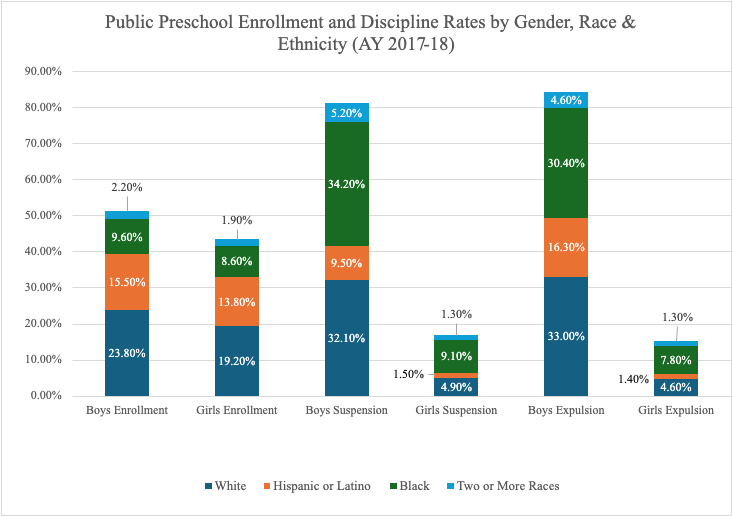
Children who hold multiple marginalized identities may be at particularly elevated risk for facing exclusionary discipline. Below, Figure 1 depicts rates of expulsions and suspensions from public prekindergarten programs in the U.S. by gender, race and ethnicity relative to enrollment levels. While Black boys comprise just under 10% of students, they receive 34.2% of suspensions and 30.4% of expulsions.17 Furthermore, Black girls receive twice as many out-of-school suspensions as White girls and nearly six times more expulsions than Hispanic/Latino girls.18 Similarly, Black and Native American students with disabilities are also more likely to be suspended than other racial/ethnic groups of students with disabilities.
- Figure 1
Early childhood education exclusionary discipline rates by gender and race/ethnicity relative to enrollment rates for the 2017--18 school year
Footnotes
An overview of exclusionary discipline practices in public schools for the 2017–18 school year.19For readability, only race and ethnicity categories that account for at least 5% of the data in one or more panels are included.

Key finding #2: The emotional well-being of the ECE workforce is associated with a reliance on or use of exclusionary discipline.
The emotional well-being of early educators has important implications for their use of exclusionary discipline. Unfortunately, teachers who work with our youngest learners routinely report higher levels of stress and depression than the national average.20 Teachers report feeling stress due to their working conditions, difficult interactions with parents, and the management of children’s behavior.21 22 23 Furthermore, ECE teachers are among the lowest-paid workers in the U.S., with nearly half reporting that they rely on public assistance to meet their basic needs.24 Highly stressful and emotional environments can make it difficult for early educators to maintain healthy relationships with children and to adequately support their learning.25
Early Educator Well-Being and Responses to Children’s Behavior
Especially in ECE, teachers spend a substantial part of their workday supporting and managing children’s challenging behavior; according to one study, nearly half of all teachers indicated that they did so more than five times a day.26 When teachers perceive their students as misbehaving, they report feeling more emotionally exhausted at work.27 However, teachers’ self-confidence in handling misbehavior buffers the impact of perceived misbehavior on exhaustion.28 In other words, teachers who feel that they are capable of dealing with misbehavior are less likely to let such behavior drain their emotional energy.
Teachers take various approaches to behavior management. However, research suggests that reactive strategies (i.e., punitive responses after unwanted behavior) are generally less effective than are proactive strategies (e.g. reiterating expectations and praising children who follow them) and that reactive strategies are associated with higher levels of teacher stress.29 Furthermore, early educators often report turning to suspension and expulsion when they feel that they have exhausted their behavior management strategies.30
Across multiple studies, early educators report experiencing high levels of emotional burnout and exhaustion, decreasing the quality of their interactions with children and increasing turnover. In fact, according to data from Louisiana, nearly one in three ECE teachers leave their teaching roles each year—a pace that is more than twice that of K-12 teachers.31 32 33 Teachers experiencing burnout on the job report feeling exhausted, emotionally distant from their students, and ineffective in the classroom.34 In early elementary grades, children in classrooms with teachers who report high levels of burnout are more likely to receive in-school suspensions.35 ECE teachers who report poorer emotional well-being and who have insufficient access to classroom behavioral supports are more likely to request a child be expelled.36 Qualitatively, teachers describe how feeling ineffective or unsuccessful in managing children’s behaviors leads to their perception of children or families as “bad” and ultimately requesting that they be expelled.37 38 In early elementary grades, teachers’ emotional exhaustion is associated with a lower threshold for tolerating minor classroom behavior challenges. Exhausted teachers refer more children to school administration for discipline as opposed to implementing effective behavior management strategies in the classroom.39
In summary, research suggests that emotionally exhausted teachers who feel ineffective in managing children’s behavior may use exclusionary discipline as a means of reducing their workplace stress and managing their own emotions. This may be especially true when resources that support educators’ classroom management are scarce. In a pair of studies, teachers who reported elevated rates of stress or depression but who had access to social-emotional supports (e.g. curriculum, coaching, and consultation) were less likely to request that children be expelled.40 41 Moreover, programs that implement supports for children’s SEL have teachers who report better emotional health, more effective behavior management, and greater job satisfaction.42
Key finding #3: Programs that integrate behavioral support and mental health consultation are associated with a lower expulsion risk, but evidence regarding their effects on actual expulsion outcomes remains mixed.
Despite increasingly robust research on intervention and prevention efforts, exclusionary practices persist across all sectors of the ECE system. Efforts to prevent exclusionary discipline in ECE have commonly focused on multitiered supports that address both children’s behavior and teachers’ knowledge and well-being.
Infant and Early Childhood Mental Health Consultation Programs
The largest and most developed research literature focuses on IECMHC, which pairs mental health professionals with educators to improve classroom climate, teacher coping, and child social-emotional development. A systematic review of IECMHC research found consistent associations between consultation and reductions in teacher stress, with indirect effects on expulsion risk.43 For example, researchers reported that consultation moderated the relationship between teacher depression and expulsion decisions, reducing the likelihood that teachers requested the permanent removal of a child.44 Similarly, teachers’ engagement in consultation was linked to significant changes in children’s prosocial behavior and reductions in challenging behaviors.45 However, randomized controlled trials have yielded mixed results. While the service helped improve children’s behavior, as rated by teachers, no effects on reducing the likelihood of expulsion were found, possibly due to inconsistent implementation and the need for sustained engagement.46
Tiered Frameworks as Intervention and Prevention Supports
Tiered frameworks, such as the Pyramid Model for Promoting Social-Emotional Competence, also show promise. The Pyramid Model provides universal strategies for all children, targeted supports for those at risk, and intensive interventions for children with persistent challenges. Although causal evidence remains limited, longitudinal data from Colorado suggest that statewide adoption of the Pyramid Model coincided with substantial declines in expulsion rates.47 These findings align with theoretical models that emphasize proactive classroom supports and family engagement.48 Similarly, adaptations of positive behavioral interventions and supports (PBIS) for ECE settings have demonstrated reductions in disciplinary referrals and improved equity in elementary contexts, suggesting potential applicability for preschool classrooms.49
Social-Emotional Learning Curricula
SEL curricula represent another widely implemented strategy. Such curricula are designed to systematically build young children’s skills in areas such as emotion understanding, self-regulation, empathy, and relationship building, often through structured, developmentally appropriate activities embedded in daily classroom routines. For example, widely used programs such as Second Step Early Learning 50 use brief, sequenced lessons, modeling (e.g., with puppets), and guided practice to help children learn to identify feelings, manage frustration, and positively engage with peers. A meta-analysis of preschool SEL interventions found significant improvements in children’s emotion regulation and social skills, which are theorized to reduce behaviors that precipitate exclusion.51 However, most studies measured child social and academic outcomes rather than expulsion rates, leaving the causal links indirect. Programs that integrate child-focused supports with teacher-focused resources, such as mental health consultation combined with SEL curricula, are most likely to succeed.52
Across these approaches, a consistent theme emerges: access to resources matters. When teachers lack behavioral supports or mental health consultation, expulsion rates rise. Conversely, interventions that strengthen teacher capacity and classroom climate can mitigate the use of exclusionary discipline. Future research should prioritize rigorous evaluations of combined models, examine mechanisms of change (e.g., teacher stress reduction), and explore scalability across diverse ECE settings.
Key finding #4: Legislative bans alone are insufficient; policy gaps in enforcement, data, and workforce support persist.
National Legislation
Despite growing legislative momentum to curb preschool expulsions, significant gaps in policy design, implementation, and accountability persist. Since Connecticut’s landmark 2015 ban, at least 15 states have enacted laws restricting or prohibiting expulsion in publicly funded programs.53 However, these policies vary widely in scope: some apply only to state prekindergarten, while others exclude childcare centers or home-based programs. Critically, most legislation stipulates desired outcomes without addressing the structural conditions that drive exclusion, such as teacher stress, large class sizes, and limited access to behavioral supports.54 For example, Illinois’ expulsion ban was associated with director-reported decreases in formal expulsions but increases in “soft” exclusions.55 Families also reported similar experiences of exclusion and difficulties accessing resources before and after the law went into effect.56
Policies rarely address the structures in ECE that indirectly contribute to teacher burnout (see key finding #2, e.g., compensation, a lack of supports, and poor job satisfaction) and can increase the reliance on ineffective or exclusionary discipline strategies. Integrating workforce supports, such as salary parity for public prekindergarten teachers and access to mental health services, along with implementing adequate social-emotional and behavioral resources should be at the foundation of holistic policy reforms.57
Exclusionary Discipline Data Systems
While it remains necessary to address the underlying structural drivers of exclusionary practices, effective policy will also focus on accountability and enforcement grounded in high-quality, locally meaningful data. Few states require programs to report disciplinary actions, and even fewer provide technical assistance or funding to implement alternatives. This absence of standardized reporting prevents policymakers from assessing whether reforms reduce expulsions or mitigate disparities.58 Without coordinated data systems that span all ECE systems and settings—home, center, and school based—efforts to track exclusion and identify inequities are severely constrained. Current gaps in data infrastructure also limit research on intersectional disparities and the effectiveness of prevention strategies. Such work is further complicated as funding and support for racial equity practices remain at risk.
Finally, policy alignment and resource integration represent critical opportunities for improvement. Quality Rating and Improvement Systems as well as Child Care and Development Fund plans could incorporate expulsion-prevention metrics and incentivize the adoption of supports such as IECMHC.59 Arkansas’ “Behavior Help” initiative offers a promising model: providers must access state-funded consultation and training before expelling a child, ensuring that exclusion is a last resort.60 Scaling such efforts nationally would require investments in data systems, technical assistance, and cross-sector collaboration.
Conclusion
Taken together, the evidence suggests that exclusionary discipline in ECE is not a marginal issue but a widespread and patterned practice that disproportionately removes historically marginalized children from learning environments during a critical developmental window. Although the literature is descriptive or correlational and strong causal inference regarding exclusionary discipline itself is minimal, several patterns emerge consistently across studies. Specifically, to date, research indicates that patterns of exclusion are closely tied not only to child behavior but also to the conditions under which educators work—particularly low-paying, highly stressful, and inadequately resourced settings—which shape how behavior is perceived and managed in classrooms. Although a growing body of intervention research points to the promise of integrated, prevention-oriented approaches that strengthen both child skills and teacher capacity, their effects on expulsion itself remain uneven and highly dependent on implementation. At the policy level, recent legislative bans represent an important shift, but their focus on prohibiting final exclusionary actions—without corresponding investments in data systems, accountability, and workforce supports—limits their potential to produce sustained change. Meaningful progress will require aligning policy-level, program-level, and classroom-level efforts to address both the structural conditions and the everyday interactions that give rise to exclusion in ECE settings.
-
Gilliam, W. S., and G. Shahar. 2006. Preschool and Child Care Expulsion and Suspension: Rates and Predictors in One State. Infants & Young Children: An Interdisciplinary Journal of Early Childhood Intervention 19(3): 228–245. https://doi.org/10.1097/00001163-200607000-00007.↩︎
-
Office for Civil Rights. 2021. An Overview of Exclusionary Discipline Practices in Public Schools for the 2017-2018 School Year. June. https://ocrdata.ed.gov/estimations/2017-2018.↩︎
-
Zeng, S., C. P. Corr, C. O’Grady, and Y. Guan. 2019. Adverse Childhood Experiences and Preschool Suspension Expulsion: A Population Study. Child Abuse & Neglect 97: 104149. https://doi.org/10.1016/j.chiabu.2019.104149.↩︎
-
Malik, R. 2017. New Data Reveal 250 Preschoolers Are Suspended or Expelled Every Day. Center for American Progress. November 6. https://www.americanprogress.org/article/new-data-reveal-250-preschoolers-suspended-expelled-every-day/.↩︎
-
Office for Civil Rights, 2021.↩︎
-
Zeng et al (2019).↩︎
-
Skiba, R. J., R. S. Michael, A. C. Nardo, and R. L. Peterson. 2002. The Color of Discipline: Sources of Racial and Gender Disproportionality in School Punishment.↩︎
-
Office for Civil Rights. 2014. Data Snapshot: Early Childhood Education. Rep. Washington, District of Columbia. pp. 1–17.↩︎
-
Zeng et al (2019).↩︎
-
Office for Civil Rights (2021).↩︎
-
Skiba, R. J., R. H. Horner, C.-G. Chung, M. K. Rausch, S. L. May, and T. Tobin. 2011. Race Is Not Neutral: A National Investigation of African American and Latino Disproportionality in School Discipline. School Psychology Review 40(1): 85–107. https://doi.org/10.1080/02796015.2011.12087730.↩︎
-
Sullivan, A. L., E. R. Van Norman, and D. A. Klingbeil. 2014. Exclusionary Discipline of Students With Disabilities: Student and School Characteristics Predicting Suspension. Remedial and Special Education 35(4): 199–210. https://doi.org/10.1177/0741932513519825.↩︎
-
Office for Civil Rights (2021).↩︎
-
Office for Civil Rights. 2023. Student Discipline and School Climate in U.S. Public Schools. Rep. Washington, District of Columbia. pp. 1–24.↩︎
-
Zeng, S., B. Pereira, A. Larson, C. P. Corr, C. O’Grady, and A. Stone-MacDonald. 2021. Preschool Suspension and Expulsion for Young Children with Disabilities. Exceptional Children 87(2): 199–216.↩︎
-
Zeng et al (2019).↩︎
-
Office for Civil Rights (2021).↩︎
-
Office for Civil Rights (2021).↩︎
-
Office for Civil Rights (2021).↩︎
-
Farewell, C. V., J. Quinlan, E. Melnick, J. Powers, and J. Puma. 2021. Job Demands and Resources Experienced by the Early Childhood Education Workforce Serving High-Need Populations. Early Childhood Education Journal 50: 197–206. https://doi.org/10.1007/s10643-020-01143-4.↩︎
-
Stauffer, S. D., and E. C. M. Mason. 2013. Addressing Elementary School Teachers’ Professional Stressors: Practical Suggestions for Schools and Administrators. Educational Administration Quarterly 49(5): 809–837. https://doi.org/10.1177/0013161X13482578; Maslach, C., W. Schaufeli, and M. P. Leiter. 2001. Job Burnout. Annual Review of Psychology 52: 397–422. https://doi.org/10.1146/annurev.psych.52.1.397.↩︎
-
Kelly, A. L., and D. C. Berthelsen. 1995. Preschool Teachers’ Experiences of Stress. Teaching and Teacher Education 11(4): 345–357. https://doi.org/10.1016/0742-051X(94)00038-8.↩︎
-
Friedman-Krauss, A. H., C. C. Raver, P. A. Morris, and S. M. Jones. 2014. The Role of Classroom-Level Child Behavior Problems in Predicting Preschool Teacher Stress and Classroom Emotional Climate. Early Education and Development 25(4): 530–552. https://doi.org/10.1080/10409289.2013.817030.↩︎
-
Quinn, E. L., B. Stover, J. J. Otten, and N. Seixas. 2022. Early Care and Education Workers’ Experience and Stress during the COVID-19 Pandemic. International Journal of Environmental Research and Public Health 19(5). https://doi.org/10.3390/ijerph19052670.↩︎
-
Jennings, P. A., and M. T. Greenberg. 2009. The Prosocial Classroom: Teacher Social and Emotional Competence in Relation to Student and Classroom Outcomes. Review of Educational Research 79(1): 491–525.↩︎
-
Clunies‐Ross, P., E. Little, and M. Kienhuis. 2008. Self‐Reported and Actual Use of Proactive and Reactive Classroom Management Strategies and Their Relationship with Teacher Stress and Student Behaviour. Educational Psychology 28(6): 693–710. https://doi.org/10.1080/01443410802206700.↩︎
-
Tsouloupas, C. N., R. L. Carson, R. Matthews, M. J. Grawitch, and L. K. Barber. 2010. Exploring the Association between Teachers’ Perceived Student Misbehaviour and Emotional Exhaustion: The Importance of Teacher Efficacy Beliefs and Emotion Regulation. Educational Psychology 30(2): 173–189. https://doi.org/10.1080/01443410903494460.↩︎
-
Tsouloupas et al (2010).↩︎
-
Stauffer et al (2013).↩︎
-
An, Z. G., and E. Horn. 2022. Through the Lens of Early Educators: Understanding the Use of Expulsion and Suspension in Childcare Programs. Early Childhood Research Quarterly 60: 379–389. https://doi.org/10.1016/j.ecresq.2022.03.008.↩︎
-
Ng, J., M. Rogers, and C. McNamara. 2023. Early Childhood Educator's Burnout: A Systematic Review of the Determinants and Effectiveness of Interventions. Issues in Educational Research 33(1): 173–206.↩︎
-
Ansari, A., R. C. Pianta, J. V. Whittaker, V. E. Vitiello, and E. A. Ruzek. 2022. Preschool Teachers’ Emotional Exhaustion in Relation to Classroom Instruction and Teacher–Child Interactions. Early Education and Development 33(1): 107–120.↩︎
-
Bassok, D., A. J. Markowitz, L. Bellows, and K. Sadowski. 2021. New Evidence on Teacher Turnover in Early Childhood. Educational Evaluation and Policy Analysis 43(1): 172–180.↩︎
-
Maslach, Schaufeli, and Leiter (2001).↩︎
-
Eddy, C. L., F. L. Huang, D. R. Cohen, K. M. Baker, K. D. Edwards, K. C. Herman, and W. M. Reinke. 2020. Does Teacher Emotional Exhaustion and Efficacy Predict Student Discipline Sanctions? School Psychology Review 49(3): 239–255. https://doi.org/10.1080/2372966X.2020.1733340.↩︎
-
Silver, H. C., and K. M. Zinsser. 2020. The Interplay among Early Childhood Teachers’ Social and Emotional Well-Being, Mental Health Consultation, and Preschool Expulsion. Early Education and Development 31(7): 1133–1150. https://doi.org/10.1080/10409289.2020.1785267.↩︎
-
Martin, K. A., E. Bosk, and D. Bailey. 2018. Teachers’ Perceptions of Childcare and Preschool Expulsion. Children & Society 32(2): 87–97.↩︎
-
Zulauf, C. A., and K. M. Zinsser. 2019. Forestalling Preschool Expulsion: A Mixed-Method Exploration of the Potential Protective Role of Teachers’ Perceptions of Parents. American Educational Research Journal 56(6): 2189–2220. https://doi.org/10.3102/0002831219838236.↩︎
-
Eddy et al (2020).↩︎
-
Silver et al (2020).↩︎
-
Zinsser, K. M., C. A. Zulauf, V. Nair Das, and H. Callie Silver. 2019. Utilizing Social-Emotional Learning Supports to Address Teacher Stress and Preschool Expulsion. Journal of Applied Developmental Psychology 61: 33–42. https://doi.org/10.1016/j.appdev.2017.11.006.↩︎
-
Zinsser, K. M., C. G. Christensen, and L. Torres. 2016. She’s Supporting Them; Who’s Supporting Her? Preschool Center-Level Social-Emotional Supports and Teacher Well-Being. Journal of School Psychology 59: 55–66. https://doi.org/10.1016/j.jsp.2016.09.001.↩︎
-
Silver, H. C., A. E. Davis Schoch, A. M. Loomis, C. E. Park, and K. M. Zinsser. 2023. Updating the Evidence: A Systematic Review of a Decade of Infant and Early Childhood Mental Health Consultation (IECMHC) Research. Infant Mental Health Journal 44(1): 5–26. https://doi.org/10.1002/imhj.22033.↩︎
-
Silver et al (2020).↩︎
-
Conners Edge, N. A., A. Kyzer, A. E. Davis, and K. Whitman. 2022. Infant and Early Childhood Mental Health Consultation in the Context of a Statewide Expulsion Prevention Initiative. Journal of Educational and Psychological Consultation 32(3): 315–336. https://doi.org/10.1080/10474412.2021.1983440.↩︎
-
Gilliam, W. S., A. N. Maupin, and C. R. Reyes. 2016. Early Childhood Mental Health Consultation: Results of a Statewide Random-Controlled Evaluation. Journal of the American Academy of Child & Adolescent Psychiatry 55(9): 754–761. https://doi.org/10.1016/j.jaac.2016.06.006.↩︎
-
Vinh, M., P. Strain, S. Davidon, and B. J. Smith. 2016. One State’s Systems Change Efforts to Reduce Child Care Expulsion: Taking the Pyramid Model to Scale. Topics in Early Childhood Special Education 36(3): 159–164. https://doi.org/10.1177/0271121415626130.↩︎
-
Clayback, K. A., and M. L. Hemmeter. 2021. Exclusionary Discipline Practices in Early Childhood Settings: A Survey of Child Care Directors. Early Childhood Research Quarterly 55: 129–136. https://doi.org/10.1016/j.ecresq.2021.01.002.↩︎
-
Bradshaw, C. P., M. M. Mitchell, L. M. O’Brennan, and P. J. Leaf. 2010. Multilevel Exploration of Factors Contributing to the Overrepresentation of Black Students in Office Disciplinary Referrals. Journal of Educational Psychology 102(2): 508–520. https://doi.org/10.1037/a0018450; Vincent, C. G., J. Swain-Bradway, T. J. Tobin, and S. May. 2011. Disciplinary Referrals for Culturally and Linguistically Diverse Students with and without Disabilities: Patterns Resulting from School-Wide Positive Behavior Support. Exceptionality 19(3): 175–190. https://doi.org/10.1080/09362835.2011.595791.↩︎
-
Collaborative for Academic, Social, and Emotional Learning. 2024. Second Step: Early Learning Curriculum. CASEL Program Guide. October 7. https://pg.casel.org/second-step-early-learning-curriculum/.↩︎
-
Murano, D., J. E. Sawyer, and A. A. Lipnevich. 2020. A Meta-Analytic Review of Preschool Social and Emotional Learning Interventions. Review of Educational Research 90(2): 227–263. https://doi.org/10.3102/0034654320914743.↩︎
-
Zinsser et al (2019).↩︎
-
Loomis, A. M., A. Davis, G. Cruden, C. Padilla, and Y. Drazen. 2022. Early Childhood Suspension and Expulsion: A Content Analysis of State Legislation. Early Childhood Education Journal 50(3): 327–344. https://doi.org/10.1007/s10643-021-01159-4.↩︎
-
Gilliam et al (2006).↩︎
-
Zinsser, K. M., H. C. Silver, and E. Shenberger. 2021. Evaluating the Implementation of the Illinois Expulsion Law 2017–2020. Findings and Recommendations Three Years Later. The University of Illinois Chicago, Chicago IL. www.setllab.com/briefreports.↩︎
-
Zinsser, K. M., S. Coba-Rodriguez, and A. Lowe-Fotos. 2024. A Qualitative Comparison of Parents’ Experiences of Early Childhood Expulsion Following a Legislative Ban. International Journal of Child Care and Education Policy 18(1). https://doi.org/10.1186/s40723-024-00132-z.↩︎
-
Allen, R., S. Meek, B. Alexander, C. Palomino, D. Blevins, E. Catherine, K. McIntosh, M. L. Hemmeter, T. Powell, and X. Soto-Boykin. 2022. A Holistic Approach to Ending Exclusionary Discipline for Young Learners: A Review of the Data, Research, and Multi-Dimensional Solutions. Arizona State University. https://childandfamilysuccess.asu.edu/sites/default/files/2022-09/exclusionary-discipline-093022-1.pdf.↩︎
-
Zinsser, K. M., H. C. Silver, E. R. Shenberger, and V. Jackson. 2022. A Systematic Review of Early Childhood Exclusionary Discipline. Review of Educational Research 92(1): 1–43. https://doi.org/10.3102/00346543211070047.↩︎
-
Buell, M., S. Kuntz, A. Whitaker, J. T. Hustedt, G. Slicker, and W. Woelki. 2024. Policies Addressing Suspension and Expulsion in State Early Care and Education Subsystems: A National Census of Policy Alignment and Integration. Early Childhood Research Quarterly 67: 191–207. https://doi.org/10.1016/j.ecresq.2023.12.009.↩︎
-
Chow, K. A., S. Smith, C. E. Park, T. Grindal, and N. A. C. Edge. 2024. Implementation of a Comprehensive State Effort to Reduce Exclusionary Discipline in Early Care and Education Settings: Arkansas’s Policy. Early Childhood Research Quarterly 67: 330–342. https://doi.org/10.1016/j.ecresq.2024.01.007.↩︎
Suggested Citation
Zinsser, Katherine and Allegra Hinojosa-Cabrera (2026). "Preschool Discipline," in Live Handbook of Education Policy Research, in Douglas Harris (ed.), Association for Education Finance and Policy, viewed 10/05/2026, https://livehandbook.org/k-12-education/workforce-teachers/early-education/quality-and-accountability/preschool-discipline/.