Returns to Graduate Education
Key Findings
- Key Finding 1
On average, workers with graduate degrees earn much more than others, but returns vary widely across types of degrees.
Simple comparisons of average earnings can yield biased estimates of the true impact graduate degrees have on earnings. Research identifying the causal effect of graduate study on earnings finds that juris doctor (JD) and doctor of medicine (MD) attainment increases earnings by around 50% and 80%, respectively, over what those degree holders would likely have earned had they not gone to graduate school. The master of business administration (MBA) also yields a modest increase in earnings of around 10–15%. A master of arts in humanities fields, such as history and fine arts, yields zero or negative effects on earnings.
- Key Finding 2
Accounting for the costs of graduate programs can lead to a reranking of the programs' net financial value.
Different graduate degrees require significantly different levels of investment. This variation comes from differences not only in tuition but also in program length and ability to work part-time during enrollment. For example, while 2% of JD and MD students work part-time, more than 70% of MBA students and 90% of students pursuing a master’s in education administration work at least part-time. The difference in investment implies that taking costs into account can radically change the relative value of programs. For example, although a master’s in educational administration increases earnings by 9% and a JD by around 50%, once degree costs are accounted for, the net returns on investment are 16% for the former and 22% for the latter.
- Key Finding 3
Returns to a graduate education vary across student and program characteristics.
Women generally gain more than men from graduate degrees, with the notable exceptions of nursing and certain engineering degrees. Students who majored in lower-earning fields in college gain more than those with higher-earning majors from graduate degrees. Higher-ranked programs yield larger returns for MBA and JD holders, but ranking is less relevant for other degrees.
Introduction
Graduate education has become an important part of higher education. In the U.S., the percentage of college graduates aged 35–39 with a graduate degree increased from 31% in 1993 to 42% in 20221. The rapid growth of graduate education reflects the economy’s increasing demand for a highly skilled labor force and the higher education sector’s corresponding increase in supply of graduate degree programs234. Graduate study is costly, however, in terms of both direct spending on tuition, fees, and supplies and the indirect cost of forgone earnings. This has led to growing concerns about tuition, borrowing, and whether all graduate programs deliver net economic benefits to students and society5.
Students care about the return to graduate education—the additional income they will earn with a graduate degree—rather than what they would have made had they not pursued further education. This expected lifetime return is a critical element of their decision to invest time and money in graduate education. Most importantly, they care about expected returns to their specific graduate degrees and circumstances. A master’s in education corresponds with a very different set of jobs and earnings pathways than an advanced degree in medicine. In other words, it is important to understand how returns to graduate degrees vary by degree type, program, and student characteristics.
Therefore, evidence on the returns to graduate study and how the returns differ across specific degrees is critical for both policymakers and students. The empirical literature on returns to graduate degrees is nascent, and much work is needed to satisfy the demand for evidence from policymakers and students. In the remainder of this chapter, I (1) review the descriptive and causal literature on the returns to graduate degrees, (2) point out areas where further research is required, and (3) discuss policy implications of the findings.
Evidence
Key finding #1: On average, workers with graduate degrees earn much more than others, but returns vary widely across types of degrees.
Simple statistics show that graduate degree holders perform better in the labor market—they have higher average earnings and are likelier to be employed.6 However, comparing the average earnings after graduate school is a poor way to gauge the returns to graduate programs. Students sort into college majors and graduate programs on the basis of both their absolute advantage in labor market ability and their comparative advantage in field-specific talents.7 For example, students in majors with higher average quantitative GRE scores are less likely but students in majors with higher average verbal GRE scores more likely to attend graduate school.8 This leads to classic selection bias or endogeneity in naive comparisons—it is unclear whether the difference in average earnings reflects the value of graduate school or the differences in individuals’ quantitative and verbal skills. This is related to the challenge in estimating the returns to undergraduate education.
Rigorous evidence on the returns to graduate degrees is hard to produce because of two further challenges beyond endogeneity. First, graduate education spans a wide range of degrees, from the MD, JD, and MBA to the master of arts (MAs) in art history and master of science (MS) in nursing, among many more. These degrees differ vastly in their admission requirements, curricula, and specialization and are expected to have different labor market values. Accordingly, an overall estimate of the returns to graduate school is highly limited in its policy and practical value. Producing estimates of the value of hundreds of graduate degrees, however, involves solving hundreds of endogeneity issues, which complicates research design.
Second, different graduate programs differ widely in their required investment. Although tuition indeed differs widely between programs, programs also differ widely in length (as in the case of, e.g., the MD vs. the MA) and course load (as in the case of, e.g., the JD vs. the MBA), which leads to large differences in the feasibility of part-time enrollment and completion rates.9 These other dimensions of costs are more pronounced for graduate than for undergraduate studies and are therefore more important in assessing the returns to graduate degrees.
Research on the returns to graduate degrees comes in two flavors. The first group of studies examines the returns to a wide range of graduate programs with regression methods accounting for individual characteristics that may differ between those with and without graduate degrees. Another group of studies leverages specialized data and natural experiments to estimate the returns to a narrow set of graduate degrees. Below, I review the major takeaways from the research using both approaches.
One lesson is that simple differences in earnings with and without a graduate degree misstate the causal returns to graduate education. Simple statistical analyses such as ordinary least squares (OLS) regressions offer one solution to this problem by controlling for differences in observable student characteristics such as gender, ethnicity, and parental education. One study shows, however, that even OLS can yield biased estimates of the returns to graduate degrees. Instead, the study uses an extension of the fixed effect (FE) method and essentially compares the earnings of individuals before and after they attain graduate degrees. This empirical approach, which I refer to as the FEcg method, is uniquely suitable to the estimation of the value of graduate degrees because most graduate students work before enrolling in graduate school. The study finds that OLS overestimates the returns to an MD by 25%, to a JD by 10%, and to an MBA by more than 150%.10 Interestingly, OLS could underestimate the returns to other graduate degrees, as well, mostly lower-earning degrees: It underestimates the returns to a master’s in psychology by 72%.11 Research also finds that it is critical to control for undergraduate major and undergraduate GPA in comparisons of individuals’ earnings to gauge the returns to graduate degrees.12
A few studies on the returns to a broad range of graduate programs categorize graduate degrees into aggregated fields, such as the MD, health-related master’s degrees, the MBA, master’s degrees in humanities, and so forth. Though the studies use different datasets, categorizations of fields, and regression methods, there are several consistent patterns. First, health-related graduate degrees generally yield significant returns, with the MD increasing income by around 80% and other health-related master’s degrees yielding around a 40% increase in income. Second, the MBA and other business-related master’s degrees yield a healthy return to income of around 10%. Third, master’s degrees in arts and humanities fields consistently yield zero or negative returns.13,14 All of the above return estimates leverage either the FE or the FEcg method and are derived relative to what those who attained each graduate degree would likely have earned had they not enrolled in graduate school.
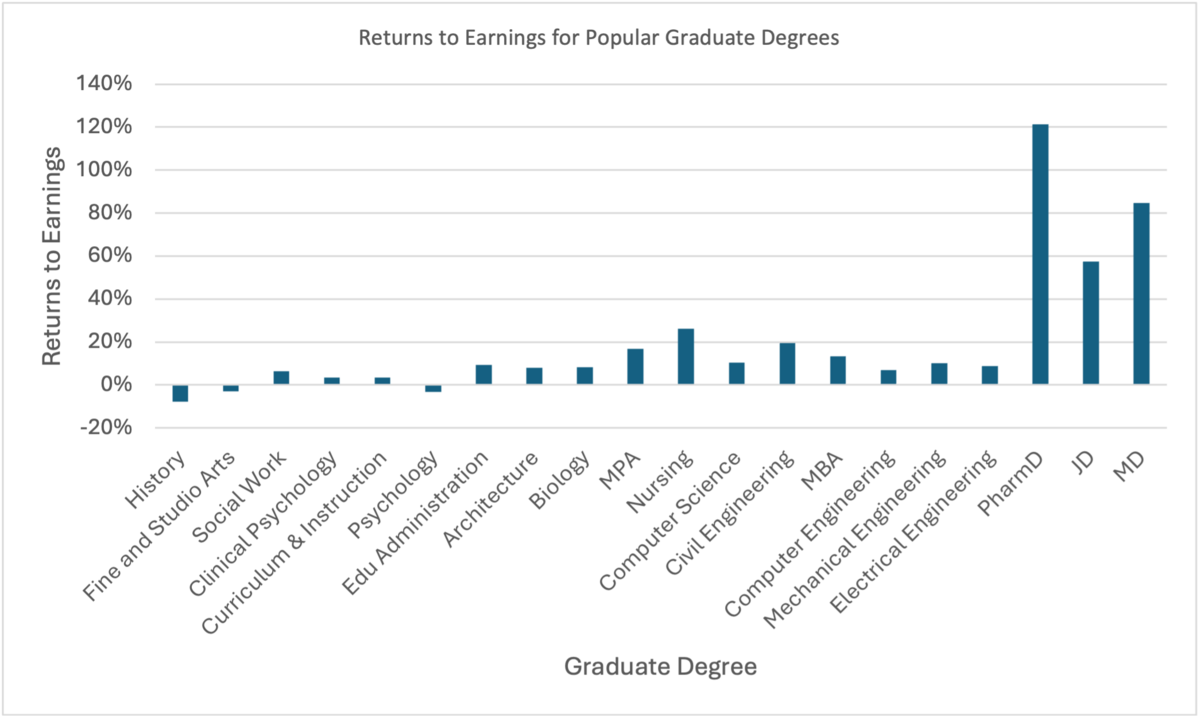
More recent research leverages the richness of administrative data to estimate the returns to a broad range of specific graduate degrees, such as the master’s in curriculum and instruction (as opposed to the more aggregated master’s in education). This research also applies the FEcg approach to control for fixed student characteristics not observable to the researcher. The bottom-line finding is consistent with the findings discussed in the previous paragraph—returns to graduate degrees vary substantially across fields. Popular professional degrees, including the JD, MD, and MBA, yield healthy returns to income of 57%, 85%, and 13%, respectively. The returns to a master’s in history, fine arts, or other humanities field are negative. Interestingly, even the returns to specific degrees within the same broad field can vary significantly. For example, within engineering fields, civil engineering increases earnings by around 20%, while computer, mechanical, and electrical engineering increase earnings by around 7–10%.15
- Figure 1
Returns to Earnings for Popular Graduate Degrees
Footnotes
This figure reports the estimates for the earnings returns to some of the most popular graduate degrees in the US. The returns are relative to what individuals with each graduate degree likely would have earned had they not enrolled in graduate school.

In addition to the above papers, which look at a wide range of graduate degrees, several papers focus on narrower contexts that allow the researchers to more accurately pinpoint the effect of graduate education on later earnings for specific, popular graduate degrees. For example, one study leverages a panel of GMAT test participants to study the returns to an MBA. Information on individual earnings before and after the MBA indicate that this graduate education pathway increases earnings by around 5%.16 Though this is lower than the estimates discussed in the previous paragraphs, the panel data are from the 1990s and span only 8 years including before and after graduate school.
Previous works also look at the returns to an MD, leveraging an interesting natural experiment. In the Netherlands, admission to medical school is partly decided via lottery. Exploiting this random access to medical school, researchers estimate that admission increased earnings by around 65% 22 years later.17 This broadly aligns with the previously discussed findings for the US. The returns may vary significantly even across medical specialties. Research using the Survey of Young Physicians and the American Medical Association’s Socio-Economic Monitoring Survey shows that the average American surgeon earned over $269,000 while family practice doctors earned $131,200.18 Controls for hours of work, residency training, and observed and unobserved ability account for only half of this difference between these specialties.
The studies described so far, except the one from the Dutch medical schools, are all U.S. focused. Therefore, it is worth discussing some results using UK data. Using the Longitudinal Education Outcomes (LEO) data, an OLS study shows a return of more than 20% to law and of 15–20% to business. Surprisingly, the authors find a 5–10% return to medicine for women but a negative return to medicine for men. (This lower return to medicine is due to the substantially lower pay for doctors in the UK, potentially attributable to the publicly funded National Health Service acting as monopsony employer of doctors.) They also find significantly negative returns to humanities graduate degrees.19
Key finding #2: Accounting for the costs of graduate programs can lead to a reranking of the programs' net financial value.
Graduate school is costly, with substantial borrowing involved. In addition, graduate student borrowing is highly sensitive to policy, and there are concerns about the amount of debt students take on.20,21 Accordingly, from both a policy perspective and the perspective of students choosing among graduate programs, it is important to incorporate costs into the analyses of returns to investment.
Differences in the costs of enrollment across graduate programs are driven not only by tuition differences but also by program length and the possibility of part-time enrollment. The average full-time (sticker) tuition for public institutions in 2019 reported by the National Center for Education Statistics (NCES) was $18,200 for a JD, $14,516 for an MD, $10,148 for an MBA, and $7,344 for a master’s in education. Using administrative data on part-time earnings and duration of enrollment, researchers calculate that the median duration of enrollment is 4 years for MD, 3 years for JD, and 2.3 years for MBA and master’s in education. In addition, they calculate that only 2% of MD and JD students are enrolled part-time while 74% of MBA students and 91% of master’s in education students are enrolled part-time. Relatedly, they find that the average annual earnings while enrolled are $10,469 for MD, $20,051 for JD, $46,971 for MBA, and $39,998 for master’s in education students.22
The large dispersion in investments impacts the investment value of graduate programs, which we measure with the net present discounted value (PDV) and the internal rate of return (IRR). The IRR is the interest rate at which the student would be indifferent between enrolling in the graduate program and not going to graduate school. Intuitively, if a graduate program is valuable relative to the investment required, the student would choose to enroll even if the upfront resources could generate substantial interest from an alternative, noneducation investment. A simple calculation using the College Scorecard data implies that the median master’s degree yields a net gain of $83,000 in terms of PDV while 40% of graduate degrees yield zero to negative net gain.23 This calculation demonstrates the wide range of net value of graduate degrees but is subject to the endogeneity issue mentioned previously.
A recent study that addresses this endogeneity and accounts for investment costs delivers a substantial revision of the value of graduate programs. For example, while naive estimates imply that a master’s in educational administration increases earnings by 9% and a JD by around 50%, once the cost of the degrees is incorporated, the IRR estimates are 0.16 for the former and 0.22 for the latter.24 Notice, however, that the IRR is independent of the scale of the investment. For example, while a master’s in educational administration has a relatively high IRR, the dollar gain in net PDV is not significant because the scale of investment is small.
Another study incorporates the cost of enrollment in the evaluation of value of medical graduate degrees. Using a PDV framework, the study compares the value of investing in medical school (an MD) versus entering a physician assistant (PA) program. The authors find that, compared to entering a PA program, undertaking an MD program is a positive PDV investment for the median man but not for the median woman.25
Key finding #3: Returns to a graduate education vary across student and program characteristics.
Student characteristics
Many studies examine how the returns to undergraduate majors may differ across different student populations. Relatedly, recent studies examine how the returns to graduate education might differ across students with different backgrounds. They find substantial differences across genders. In general, women have higher returns to graduate degrees than men for the same degree.26,27 Notable exceptions to this pattern are nursing and a handful of engineering fields.28 This could be explained by the greater demand for men in the corresponding industries.
Studies also examine how the returns to graduate degrees differ by race and ethnicity. The results are mixed. One study finds that White students have significantly higher returns than Black students (16% vs. 11%).29 Another study finds limited difference by race and ethnicity except for Asian students, who experience lower returns for almost all graduate degrees.30 The study is not able to attribute this pattern to college GPA, college major, or pre–graduate school earnings.
In addition, studies have examined how returns to graduate degrees differ by students’ undergraduate major and undergraduate GPA. Generally, students with lower-earning undergraduate majors gain more value from higher-earning graduate programs. In some sense, graduate school serves as a “second chance” for students with lower-earning undergraduate majors.31,32
Research finds a weak negative relation between students’ undergraduate GPA and returns to graduate programs. However, MBA and JD programs are notable exceptions, where students with a higher undergraduate GPA enjoy higher returns: A one-point increase in GPA increases the returns to the JD and the MBA by around 25% and 10%, respectively.33 This may be related to how returns to programs depend on ranking, which I discuss next.
Program characteristics
When deciding their investments in graduate education, students choose not only what but also where to study. For example, for most people, an MBA from Harvard Business School is not the same as an MBA from a lower-ranking public university. A recent study examines how the returns to graduate programs differ by ranking, taking advantage of student-level data that include information on all of the MBA programs where a student applied to enroll and all of the programs where they were admitted. In essence, the authors compare students who applied to and were admitted to the same set of schools but chose to attend different ones within the set.34 They find that a 20-spot improvement in program ranking increases returns to an MBA by around 30% and returns to a JD by around 10%. The estimated returns to unranked MBA programs are close to zero. By contrast, the authors do not find a significant relationship between program ranking and returns to a master’s in nursing, master’s in social work, or doctor of pharmacy.35 This finding is consistent with another recent study that finds no returns to program quality except for MBA and professional degree programs, where program quality is positively correlated with earnings.36
An audit study on the value of an MBA from different programs supports the above finding. The researcher submitted mock resumes in response to job advertisements. The resumes were identical except for the degree (bachelor’s or MBA) and, among the MBA holders, type of institution (for-profit, online, or regional public). Less selective institutions such as these enroll the majority of MBA students. The results showed that applicants with MBAs from these institutions did not receive higher employer responses than applicants with only BA degrees.37
Policy implications
The results reviewed in this chapter have several policy implications, all of which are related to the debates on how to use earnings for accountability in higher education. Policymakers increasingly view graduate education through an accountability lens: Which programs should expand, reform, or face tighter oversight? Which programs create value for students and taxpayers? Recent regulations in the U.S., including the Financial Value Transparency and Gainful Employment (FVT/GE), are geared toward this purpose. The FVT/GE was introduced in 2024 and calculates two main measures of programs’ economic value: D/E, the ratio of students’ debt to median annual earnings after graduation; and EP, the premium of students’ median postgraduation earnings over either the average earnings of bachelor’s holders in the state or the average earnings of bachelor’s holders in their field of study, whichever is less.
First, the wide range of returns indicates that reporting quantitative measures for accountability at the specific program level is indeed necessary. As discussed above, even different degrees in closely related fields can yield substantially different returns.38,39
Second, research to date suggests that average post–graduate school earnings, or similar measures such as the earnings premium (EP) measure proposed in the recent FVT/GE regulations, are likely misleading. Average post–graduate school earnings would suggest that electrical engineering programs yield more financial value than master of public administration (MPA) programs, which contrasts with causal estimates.40,41 At the very least, comparison with pre–graduate school earnings of students in the same program is necessary to account for differences in individuals’ earnings potential.
Third, the importance of accounting for direct and indirect costs in the returns to graduate degrees suggests that tuition, time-to-degree, and earnings during enrollment are all important measures to report for financial transparency. Focusing on earnings alone would risk incentivizing aggressive debt accumulation that might not be justified by the returns.
Finally, the many dimensions of the differences in returns by student characteristics suggest that some level of targeting may be appropriate for the design of policies to incentivize graduate school enrollment. When it comes to graduate education, one size does not fit all.
Directions for future research
Finally, I briefly discuss several areas where the evidence is particularly thin and more research is needed.
First, there are many potential mechanisms for the returns to graduate education. The most obvious is that graduate curricula teach students skills beyond what is offered in undergraduate programs. However, many additional mechanisms are feasible. For professions such as law and medicine, the corresponding graduate degrees (JD and MD) are virtually required to practice. In this sense, the graduate degrees serve as a gateway to otherwise unattainable jobs. In addition, graduate programs may introduce students to highly valuable social networks. The network effect of an MBA is a good example of such a mechanism42.
Second, graduate education might not only affect the level of individual earnings but also raise the floor of potential employment outcomes. A graduate degree might make it easier to be hired in the first place or move between jobs, and it might provide insurance against job loss in a weak labor market43.
Third, given the high level of specificity of graduate degrees, it is likely that the returns to graduate degrees are more susceptible than those of undergraduate degrees to the ebbs and flows of industry trends. As research data become more capable of tracking students further into their careers, the effect of graduate degrees on long-run income will prove an interesting area to study.
Fourth, given the rapid expansion of graduate education, the general equilibrium effect of supply expansions and financing policies is worth further study. Relatedly and more specifically, it would be important to understand if the newly launched graduate programs, many of which are for-profit, yield the same level of returns as more established graduate programs.
Finally, there is little evidence on the effects of graduate degrees on nonpay outcomes. Most graduate school enrollments happen when students are in their twenties and early thirties, a period that overlaps with the timing of many major life events. In addition, although many graduate programs may not yield high returns to individual earnings, their positive effects on society may be more pronounced. Master’s degrees in social work and clinical psychology are potential examples.
Endnotes and References
-
US Census Bureau. 2023. Educational Attainment in the United States: 2022. United States Census Bureau.↩︎
-
Blagg, Kristin. 2022. Have Earnings for Graduate Degree Recipients Changed? (Center on Education Data and Policy). Urban Institute.↩︎
-
Kelchen, Robert, and Faith Barrett. 2024. Exploring the Growth of Master’s Degree Programs in the United States (Postsecondary Equity & Economics Research Project). George Washington University, Columbia University, and Student Defense. ↩︎
-
Lindley, Joanne, and Stephen Machin. 2016. The Rising Postgraduate Wage Premium. Economica 83 (330): 281–306.↩︎
-
Monarrez, Tomas, and Jordan Matsudaira. 2023. Trends in Federal Student Loans for Graduate School. U.S. Office of the Chief Economist, Department of Education.↩︎
-
Bureau of Labor Statistics. 2025. Education Pays, 2024 (Data on Display). U.S. Bureau of Labor Statistics.↩︎
-
Altonji, Joseph G., Peter Arcidiacono, and Arnaud Maurel. 2016. The Analysis of Field Choice in College and Graduate School: Determinants and Wage Effects. In Handbook of the Economics of Education. Edited by Eric A. Hanushek, Stephen Machin, and Ludger Woessmann. North Holland.↩︎
-
Song, Moohoun, Peter F. Orazem, and Darin Wohlgemuth. 2008. The Role of Mathematical and Verbal Skills on the Returns to Graduate and Professional Education. Economics of Education Review 27 (6): 664–675.↩︎
-
Denning, Jeffrey T., and Lesley J. Turner. 2025. The Graduation Part II: Graduate Program Graduation Rates. Journal of Public Economics 248.↩︎
-
Altonji, Joseph G., and Ling Zhong. 2021. The Labor Market Returns to Advanced Degrees. Journal of Labor Economics 39 (2): 303–360.↩︎
-
Altonji and Zhong, 2021.↩︎
-
Altonji, Joseph G., and Zhengren Zhu. 2025. Returns to Specific Graduate Degrees: Estimates Using Texas Administrative Records. NBER Working Paper: 33530.↩︎
-
Altonji and Zhong, 2021.↩︎
-
Minaya, Veronica, Judith Scott-Clayton, and Rachel Yang Zhou. 2024. Heterogeneity in Labor Market Returns to Master’s Degrees: Evidence from Ohio. Research in Higher Education 65 (5): 775–793.↩︎
-
Altonji and Zhu, 2025.↩︎
-
Arcidiacono, Peter, Jane Cooley, and Andrew Hussey. 2008. The Economic Returns to an MBA. International Economic Review 49 (3): 873-899.↩︎
-
Ketel, Nadine, Edwin Leuven, Hessel Oosterbeek, and Bas van der Klaauw. 2016. The Returns to Medical School: Evidence from Admission Lotteries. American Economic Journal: Applied Economics 8 (2): 225–254.↩︎
-
Bhattacharya, Jayanta. 2005. Specialty Selection and Lifetime Returns to Specialization within Medicine. Journal of Human Resources 40 (1): 115–143.↩︎
-
Britton, Jack, Franz Buscha, Matt Dickson, Laura van der Erve, Anna Vignoles, Ian Walker, Ben Waltmann, and Yu Zhu. 2020. The Earnings Returns to Postgraduate Degrees in the UK (Research Report). Institute for Fiscal Studies.↩︎
-
Black, Sandra, Lesley J. Turner, Jeffrey Denning. 2023. PLUS or Minus? The Effect of Graduate School Loans on Access, Attainment, and Prices. NBER Working Paper: 31291.↩︎
-
Brown, Meta, Rajashri Chakrabarti, Wilbert van der Klaauw, and Basit Zafar. 2019. Understanding the Evolution of Student Loan Balances and Repayment Behavior: Do Institution Type and Degree Matter? (Economic Policy Review 25: 35–57). Federal Reserve Bank of New York.↩︎
-
Altonji and Zhu, 2025.↩︎
-
Cooper, Preston. 2022. Is Grad School Worth It? A Comprehensive Return on Investment Analysis. (Higher Education White Paper). The Foundation for Research on Equal Opportunity.↩︎
-
Cooper, 2022.↩︎
-
Chen, Keith M., and Judith A. Chevalier. 2012. Are Women Overinvesting in Education? Evidence from the Medical Profession. Journal of Human Capital 6 (2): 124–149.↩︎
-
Minaya, Scott-Clayton, and Zhou, 2024.↩︎
-
Altonji and Zhu, 2025.↩︎
-
Altonji and Zhu, 2025.↩︎
-
Minaya, Scott-Clayton, and Zhou, 2024.↩︎
-
Altonji and Zhu, 2025.↩︎
-
Altonji and Zhong, 2021.↩︎
-
Altonji and Zhu, 2025.↩︎
-
Altonji and Zhu, 2025.↩︎
-
Dale, Stacy Berg, Alan B. Krueger. 2002. Estimating the Payoff to Attending a More Selective College: An Application of Selection on Observables and Unobservables. Quarterly Journal of Economics 117 (4): 1491–1527.↩︎
-
Altonji and Zhu, 2025.↩︎
-
Stevenson, Adam. 2016. The Returns to Quality in Graduate Education. Education Economics 24 (5): 445–464.↩︎
-
Bennett, Christopher T. 2023. Labor Market Returns to MBAs From Less-Selective Universities: Evidence From a Field Experiment During COVID-19. Journal of Policy Analysis and Management 42 (2): 525–551.↩︎
-
Altonji and Zhu, 2025.↩︎
-
Bhattacharya, 2005.↩︎
-
Altonji and Zhong, 2021.↩︎
-
Altonji and Zhu, 2025.↩︎
-
Kalsi, Riddhi, and Robbie Samuels. 2019. Why Business School is a Great Time to Network (Business Education). Harvard Business Review.↩︎
-
Andrews, Rodney J., Scott A. Imberman, Michael F. Lovenheim, and Kevin Stange. 2024. The returns to college major choice: Average and distributional effects, career trajectories, and earnings variability. Review of Economics and Statistics: 1–45.↩︎
Suggested Citation
Zhu, Zhengren (2026). "Returns to Graduate Education," in Live Handbook of Education Policy Research, in Douglas Harris (ed.), Association for Education Finance and Policy, viewed 09/22/2026, https://livehandbook.org/higher-education/institutions-and-majors/returns-to-graduate-education/.