International Students in U.S. Higher Education
- Key Finding 1
China, and more recently India, have fueled international student growth over the last 25 years.
Higher incomes and broader access to college abroad created large cohorts of Indian and Chinese students able to study overseas, while shrinking public funding pushed U.S. universities to recruit more full-tuition-paying international students and expansions in work authorization for international students made American universities more attractive. Together, these factors sharply increased demand for U.S. degrees.
- Key Finding 2
International students increase the overall number of seats for American students because they pay full-sticker price tuition, cross-subsidizing American students, who generally pay net tuition well below sticker price.
The extent of the cross-subsidization depends on university objectives, capacity constraints, and the resources contributed. In certain highly ranked universities that maintain rigid admissions rates, a rise in the number of international students enrolled may reduce domestic enrollments.
- Key Finding 3
International students have been key contributors to STEM fields, increasing knowledge production in laboratory settings, research publications, innovation and patenting, and entrepreneurship.
Historically, international students have been most prevalent in STEM fields. U.S. policies helped further direct the recent growth in international students toward STEM departments. Hence, the effects of international students are most pronounced among STEM departments and labs.
- Key Finding 4
Rising international enrollments generally do not translate into similar increases in the skilled workforce, as policy greatly restricts international students' entry into the U.S. labor force.
Because policies heavily restrict longer-term work in the United States, transition rates of international students to U.S. labor markets are quite low. This carries several implications, including (1) loss of potential wages, tax revenues and spending in local economies, (2) changes in labor market competition and/or complementarity that may harm or help native workers, and (3) potential reductions in the total supply of STEM workers, if U.S.-born graduates cannot fill the gap left by departing international students.
Introduction
International students have a long history in the United States—Alexander Hamilton was an international student from the Caribbean—and their enrollment in U.S. higher education has doubled over the last twenty years, rising from about 500,000 in 2005 to more than 1 million today. Such growth has generated concerns over whether American students have been crowded out, while others have argued that the tuition revenues from international students cross-subsidize domestic students. They have traditionally enrolled in graduate programs, but recent patterns have included substantial growth at the undergraduate level, as well. They now make up over 6% of total postsecondary enrollment, with the distribution skewed toward graduate study: About 2.3% of undergraduates are international students, compared to roughly 16% of students at graduate level. International students are much more balanced than American students across levels, with 30% being undergraduates and 40% graduate students (around 85% of American postsecondary students are undergraduates).1
This chapter assesses the causes and consequences of this increase in international student enrollment, which has important implications for policies and stakeholders. Both the features of international students' sending countries (e.g., China’s significant economic growth) and U.S.-side factors (e.g., greater labor market access for international students) have played significant roles in this phenomenon.
Figure 1. International Student Enrollment in the U.S. – China, India, and Rest of World
- Figure 1
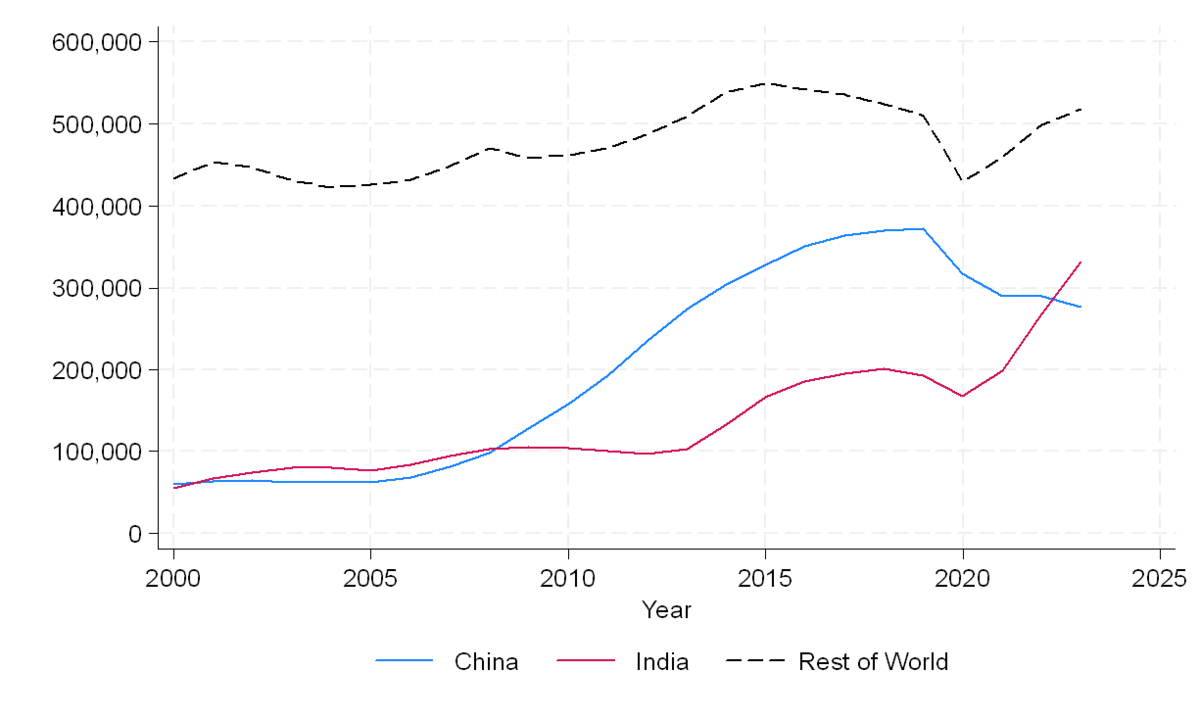

Note: The figure shows international student enrollment in U.S. higher education from Open Doors of the Institute of International Education.
Uniquely, the growth over the past two decades was driven largely by students from a single country—China—with enrollment from India rising in recent years (see Figure 1). The remarkable growth in Chinese student enrollment began in 2005 and plateaued after 2016, when Trump administration policies effectively reduced new Chinese student arrivals. As Chinese enrollments stagnated, Indian enrollments began to surge, and India has become the top sending country over the past few years.
Key areas for future research: Several open questions and areas for future research remain, including how international students impact peers and campus dynamics, their long-run effect on the economy and productivity, and the drivers and consequences of more recent trends and policy shifts.
Background
While recent growth in their enrollment has been substantial, international students have long been a part of U.S. higher education: Alexander Hamilton, founding father and first Treasury secretary, came to the United States as an international student from the British Caribbean. The presence of international students in the U.S. was first systematically examined by the 1907 Dillingham Commission, and official visa categories for them were created in the Immigration and Nationality Act of 1952.
Three visa categories currently govern international student entry. The visa class under which the vast majority of international students enter is F-1. These visas permit foreign nationals to pursue degree or certificate programs at accredited institutions. The F-1 visa lasts for the duration of the student's program of study and does not permit the individual to either remain in the United States for longer than 60 days following graduation. The J-1 visa is generally used for shorter-term exchange programs, often by individuals sponsored by their home government. Unlike F-1 visa holders, most J-1 visa holders must return home for at least 2 years after completing their study before reentering the United States. Finally, the M-1 visa exists for full-time students in approved vocational or nonacademic programs.
Alongside these visa categories exist pathways for international students to work in the United States. Curricular Practical Training (CPT) allows international students to work when such experience is integral to their program curriculum, before program completion. Optional Practical Training (OPT) allows students to work either before or after completing their program in an area related to their major field of study. OPT was originally limited to a 12-month duration and subsequently extended to 29 months for approved STEM majors in 2008. The list of STEM majors eligible for the 29-month duration was expanded in 2011 and 2012. The duration was further extended to 36 months in 2016, alongside another expansion to the list of eligible STEM majors.
In stark contrast to most other visas governing skilled immigration, international student visas and CPT/OPT authorizations are not subject to an annual limit. Further, the number of OPT authorizations now far exceeds the numbers of visas in all other categories available to college-educated foreign nationals wishing to work in the United States. The H-1B visa, traditionally the primary path for college- educated immigrants to work at private sector companies in the United States, has maintained a rigid numerical limit cap of 85,000 per year since 2004. In 2024, there were over 400,000 international students authorized to work in the United States on OPT. The uncapped nature of student visas and the CPT/OPT programs have facilitated the unprecedented growth in international enrollments in universities and the labor supply (albeit temporary) of skilled recent graduates from abroad.
Evidence
Key finding #1: China, and more recently India, have fueled international student growth over the last 25 years.
Factors from abroad
The large increase in international student enrollments began in the mid-2000s and was driven almost entirely by China until roughly 2016. In general, rising income abroad has been linked to higher international student enrollments in the U.S.2 Several factors underlie the rapid rise in the number of Chinese students. China’s accession to the World Trade Organization in 2001 led to a sizable increase in its export activity with various nations, including the United States. One study specifically finds that export-driven economic development raised incomes in China, which eventually increased the numbers of Chinese students in the United States—about 40% of the total growth in Chinese student enrollment is attributable to this channel.3 Relatedly, in 2005, China allowed the renminbi to appreciate against the dollar for the first time since 1997, which lowered the cost of U.S. tuition for Chinese students.
Apart from economic development, China underwent substantial expansions of its own higher education institutions, growing its number of college students from around 1 million in 1999 to over 9 million by 2020.4 Research has documented that this expansion in China’s undergraduate sector helped fuel growth in U.S. graduate enrollments, accounting for nearly 30% of the growth over the 2005–2015 period.5
The tremendous growth in the number of Chinese students slowed by 2016, with the ascension of the first Trump administration. More stringent requirements over English language proficiency, rhetoric targeting Chinese nationals, the expulsion of Chinese students with ties to the Chinese military, and the U.S.–China trade war of 2018 combined to effectively halt growth in enrollments from China.6
The rise in the number of international students from India began only recently but has nonetheless been substantial. Indians overtook Chinese students as the largest group of international students in the U.S. by 2020. More research is required to fully identify the sources of this rise. Economic development and limited supply of quality education institutions at home appear to be important factors.
U.S. factors
Per-student appropriations from state and local governments to higher education began declining in the 1990s, a trend that worsened after the early 2000s.7 The great recession of 2008–2010 substantially exacerbated the financial precarity of many U.S. universities. The significant decrease in government funding led public universities to seek other sources of revenue. International students, who pay sticker price (nonresident) tuition, became an attractive option for buffering against revenue losses.8 Thus, public universities—specifically those without capacity constraints—sustained large increases in international enrollment.
Apart from the quality of U.S. universities, international students consider potential postgraduation labor market opportunities in the U.S. when making enrollment decisions. Policies governing skilled immigrants' work access have substantial influence not only on international enrollments in U.S. universities but also on the quality of the students who come. For example, studies have found not only that reductions in the number of H-1B visas reduced international enrollments but also that these reductions came from the highest-ability applicants.9
While the mid-2000s saw restrictive policies that tightened the cap on H-1B visas, the mid-late 2000s saw expansions in work authorization specifically for international students. The OPT program that allowed international students to work for 1 year postgraduation was extended to 29 months in 2008 for STEM majors. The list of eligible STEM majors was expanded in 2011 and 2012, and the duration was again expanded in 2016. These reforms substantially increased both undergraduate and graduate enrollment of international students in STEM fields.10
Key finding #2: International students increase the overall number of seats for American students because they pay tuition at sticker price, cross-subsidizing American students, who generally pay net tuition well below sticker price.
A question of great importance is whether the increased admission of international students has crowded American students out of higher education. Related literature concludes that secular growth in the U.S. college-age population between 1950 and 1990 reduced higher educational attainment.11 As the higher education of American students is highly subsidized and tuition increases were limited, greater demand for college education squeezed resources, and growth in the supply of seats was restricted. Hence, a key question is the degree to which international students' tuition revenue alleviates resource constraints.
In contrast to American students, who are highly subsidized by the federal and state governments, international students usually pay tuition at sticker price. In 2019, revenue to higher education institutions from international students reached $44 billion—approximately as much as the total value of exports of soybeans, corn, and textile supplies combined.12 One study finds that at graduate level, international students on average increased enrollment of domestic students on the order of 1-for-1, as their full-price tuition payments cross-subsidized Americans.13 Related studies have found similar increases in American enrollment following growth in the numbers of international students at undergraduate level among public universities, along with increases in bachelor’s degree completion.14 This resulting increase in domestic student enrollment has also been found for the U.K., which similarly hosts large numbers of international students.15
However, these average effects mask some heterogeneity across higher education institutions. Several studies find that international students displace American students, particularly among highly ranked institutions whose objectives include preserving high quality and low admission rates.16 Instead, for such schools, international student tuition revenues increased faculty salaries and institutional grant aid to existing students.
Key finding #3: International students have been key contributors to STEM fields, increasing knowledge production in laboratory settings, research publications, innovation and patenting, and entrepreneurship.
Traditionally, international students' presence was most pronounced in graduate-level STEM departments, where they comprised nearly 50% of all STEM enrollees. By 2005, international students received the vast majority of PhDs in fields such as physics, engineering, and economics.17 The large increase in international student numbers after 2005 further expanded enrollments in graduate, but also undergraduate, STEM departments. The OPT reforms, in particular, helped encourage greater international enrollments in STEM majors and even led universities to expand their STEM degree program offerings.18
Literature has found strong associations between scientific academic research and the volume of international students in the United States. As much of scientific research is performed in labs, international students are associated with knowledge production in scientific lab settings.19 One study finds that over 50% of published articles in the leading journal Science had an international student or postdoctorate coauthor.20 Specifically in the case of Chinese students, one study finds that they improved the productivity of coethnic faculty advisors.21
International students also contribute significantly to scientific innovation. One study finds that international graduate students are associated with increased patent applications and grants to universities and non-university institutions, adding over $2 billion in value to the United States from 1965 to 2001.22 Immigrants who entered as international students, at either undergraduate or graduate level, exceed the U.S. born overall in their contributions to innovation and patenting and are on par with similarly highly educated U.S.-born STEM workers.23
Finally, international students also contribute to entrepreneurship.24 At baseline, international students demonstrate high entrepreneurial aspirations: One study finds that approximately three-quarters of Indian, European, and Chinese students indicated a desire to start a business.25 Earlier studies have found international students to be nearly twice as likely to have founded a successful start-up as comparable U.S.-born students.26 These contributions from international students appear to come specifically from those at master’s level, who have even been found to exhibit positive spillovers to entrepreneurial activity among the U.S. born.27 The case appears to be different for international PhD students in STEM fields. Despite reporting a greater desire to start a company, international PhD recipients appear less likely than comparable U.S.-born PhD holders to have actually founded companies.28 This may be due in part to the H-1B visa system, under which international PhDs working for universities and other nonprofit employers are exempt from the cap.29
Key finding #4: Rising international enrollments generally do not translate into similar increases in the skilled workforce, as policy greatly restricts international students' entry into the U.S. labor force.
Key Areas for Future Research
Several key questions remain unanswered. Areas for future research include international students' impact on peers and campus dynamics, their long-run economic and productivity impacts, and the drivers and consequences of more recent trends and policy shifts.
- Beyond their contribution to resources, other ways in which international students impact higher education warrant greater attention. These include social interactions, peer effects, classroom and campus dynamics, and university responses.
-
What factors drove the recent rise in students from India, and to what degree did the pandemic play a role in the changing composition of international enrollments?
-
What are the long-run impacts of international students on universities, labor markets, scientific knowledge and innovation, and fiscal budgets?
-
While much research has focused on factors driving international students to enroll in the United States, future work should examine the factors affecting their decision to remain in the United States in both the short and longer run.
-
How recent reductions in higher education and research funding, alongside more restrictive immigration policies, shape international student decisions—and by extension U.S. higher education—remains an important area of inquiry.
Endnotes and references
-
Data on international students by level of study are available from the Institute of International Education: https://opendoorsdata.org/data/international-students/academic-level/. Data on U.S. postsecondary enrollment by level come from Hanson, Melanie. 2025. College Enrollment & Student Demographic Statistics. EducationData.org, March 17.↩︎
- ↩︎
-
Khanna, Gaurav, Kevin Shih, Ariel Weinberger, Mingzhi Xu, and Miaojie Yu. 2025. Trade Liberalization and Chinese Students in US Higher Education. Review of Economics and Statistics 107(5): 1291–1309. ↩︎
-
Khanna, Gaurav. 2025. From Asia, With Skills (WP No. w34449). National Bureau of Economic Research.↩︎
- ↩︎
-
For a more detailed discussion, see Khanna (2025).↩︎
-
See Dynarski, Susan, Lindsay Page, and Judith Scott-Clayton. 2023. College Costs, Financial Aid, and Student Decisions. In Handbook of the Economics of Education, vol. 7, pp. 227-285. Elsevier; for detailed numbers on appropriations to higher education, see Bound, John, Breno Braga, Gaurav Khanna, and Sarah Turner. 2019. Public Universities: The Supply Side of Building a Skilled Workforce. RSF: The Russell Sage Foundation Journal of the Social Sciences 5(5): 43–66.↩︎
-
Bound John, Breno Braga, Gaurav Khanna, and Sarah Turner. 2020. A Passage to America: University Funding and International Students. American Economic Journal: Economic Policy 12(1): 97–126. ↩︎
-
See Kato, Takao, and Chad Sparber. 2013. Quotas and Quality: The Effect of H-1B Visa Restrictions on the Pool of Prospective Undergraduate Students from Abroad. Review of Economics and Statistics 95(1): 109–126; Shih, Kevin. 2016. Labor Market Openness, H‐1B Visa Policy, and the Scale of International Student Enrollment in the United States. Economic Inquiry 54(1): 121–138 ↩︎
-
Amuedo‐Dorantes, Catalina, Kevin Shih, and Huanan Xu. 2023. The Implications of Optional Practical Training Reforms on International Student Enrollments and Quality. Economic Inquiry 61(2): 253–281.↩︎
-
Bound, John, and Sarah Turner. 2007. Cohort Crowding: How Resources Affect Collegiate Attainment. Journal of Public Economics 91(5–6): 877–899.↩︎
- ↩︎
-
Shih, Kevin. 2017. Do International Students Crowd-Out or Cross-Subsidize Americans in Higher Education? Journal of Public Economics 156: 170–184.↩︎
-
Chen, Mingyu. 2021. The Impact of International Students on US Colleges: Higher Education as a Service Export (EdWorkingPaper: 21-405). Annenberg Institute at Brown University; Zhu, Julia. 2025. Comparative Immigration Policies and the Resource Effects of International Students in U.S. Higher Education (CHEPS Working Paper No. 20251202), December 9.↩︎
- ↩︎
-
Borjas, George J. 2004. Do Foreign Students Crowd Out Native Students from Graduate Programs? (WP No. 10349). National Bureau of Economic Research. Ying Shen paper↩︎
-
Bound, John, Sarah Turner, and Patrick Walsh. 2009. Internationalization of US Doctorate Education (WP No. w14792). National Bureau of Economic Research; Blanchard, Emily, John Bound, and Sarah Turner. 2008. Opening (and Closing) Doors: Country-Specific Shocks in US Doctorate Education. Doctoral Education and the Faculty of the Future. Cornell University Press.↩︎
- ↩︎
- ↩︎
- ↩︎
- ↩︎
- ↩︎
- ↩︎
-
Several skilled immigration programs, such as OPT and the H-1B program, do provide some flexibility for entrepreneurial activities. Additionally, the international entrepreneur rule provides an alternative pathway for foreign students to create businesses and remain in the U.S. to operate them.↩︎
- ↩︎
- ↩︎
- ↩︎
- ↩︎
- ↩︎
- ↩︎
- ↩︎
- ↩︎
- ↩︎
- ↩︎
- ↩︎
-
Borjas, George J. 2006. Immigration in High-Skill Labor Markets: The Impact of Foreign Students on the Earnings of Doctorates (WP No. 12085). National Bureau of Economic Research.↩︎
-
Demirci, Murat. 2020. International Students and Labour Market Outcomes of US‐Born Workers. Canadian Journal of Economics/Revue canadienne d'économique 53(4): 1495–1522.↩︎
-
For example, see Mackie, Christopher, and Francine Blau, eds. 2017. The Economic and Fiscal Consequences of Immigration. National Academies Press; Peri, Giovanni, Kevin Shih, and Chad Sparber. 2015. STEM Workers, H-1B Visas, and Productivity in US Cities. Journal of Labor Economics 33(S1): S225–S255.↩︎
-
Orrenius, Pia M., and Madeline Zavodny. 2015. Does Immigration Affect Whether US Natives Major in Science and Engineering? Journal of Labor Economics 33(S1): S79–S108; Anelli, Massimo, Kevin Shih, and Kevin Williams. 2023. Foreign Students in College and the Supply of STEM Graduates. Journal of Labor Economics 41(2): 511–563. ↩︎
-
Borjas, George J. 2000. Foreign-Born Teaching Assistants and the Academic Performance of Undergraduates. American Economic Review 90(2): 355–359.↩︎
Suggested Citation
Shih, Kevin (2026). "International Students in U.S. Higher Education," in Live Handbook of Education Policy Research, in Douglas Harris (ed.), Association for Education Finance and Policy, viewed 09/22/2026, https://livehandbook.org/higher-education/miscellaneous/international-students-in-u.s.-higher-education/.